

This Week in Politics – January 26–February 1, 2026 – Weekly Political News Recap
his week’s political landscape was shaped by deepening controversies over immigration enforcement, high-stakes diplomacy on the Ukraine war, shifting electoral ground in the United States, global backlash against U.S. security deployments, and growing concerns about the finances of major international institutions. The tensions between federal authority and local governance, as well as international cooperation versus national interest, continued to animate political discourse. Below is your Political News Recap for January 26–February 1, 2026, with clear explanations of what happened and why it matters.
What Happened: U.S. ICE Deployment at the Olympics Sparks International Backlash
Why It Matters
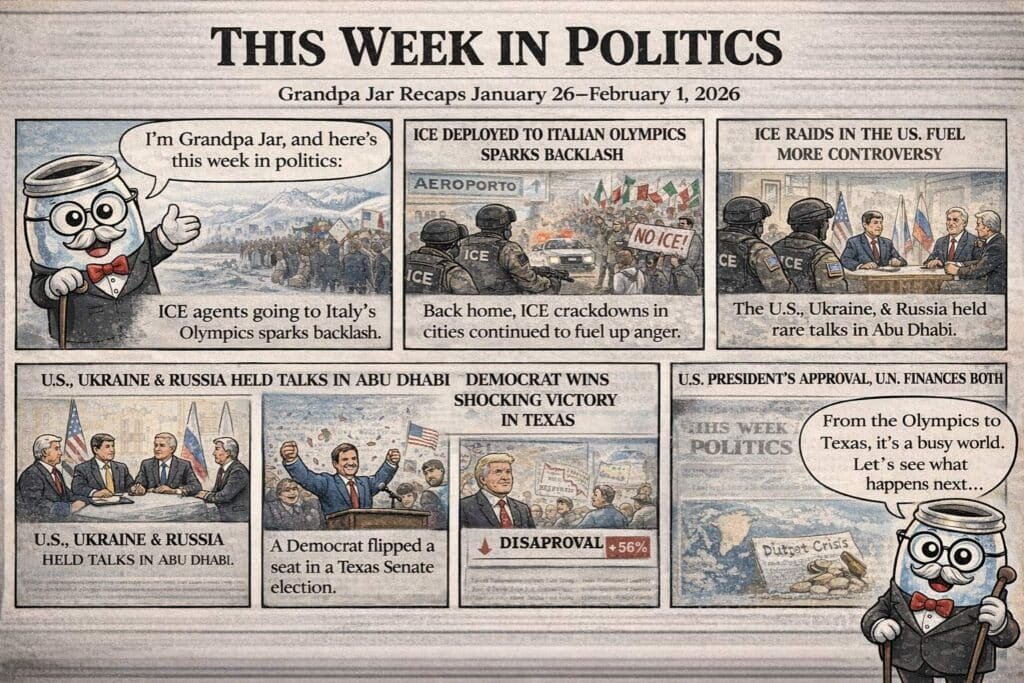
The announcement that U.S. Immigration and Customs Enforcement (ICE) agents would be deployed to assist with security at the 2026 Winter Olympics in Italy triggered significant criticism from Italian politicians, civic groups, and labor unions. Critics voiced concerns about ICE’s human rights record—especially in light of fatal shootings by federal agents in Minnesota earlier this month—and argued that their presence at a global sporting event could tarnish the United States’ image abroad. Italian leaders sought to reassure the public by clarifying that ICE’s role would be limited to operations on U.S. diplomatic premises.
This story matters because it reflects how domestic law enforcement policies can have international diplomatic ramifications. What may be seen as a domestic issue—agency deployments and immigration enforcement—can become a wedge in foreign political discourse when those policies are transferred to an international context like the Olympics. The controversy underscores how interconnected domestic and global politics have become, particularly in an era where images and narratives circulate instantly across borders. It also illustrates the reputational risks that can accompany international cooperation when public sentiment is already polarized.
What Happened: Bipartisan Scrutiny of ICE Enforcement Continues in U.S. Cities
Why It Matters
Back home, the political controversy over ICE enforcement that began with fatal shootings in Minneapolis carried into this week, with protests and political debates in major U.S. cities. Local and state leaders questioned federal enforcement tactics, and some Democratic officials called for greater oversight and transparency. At the same time, momentum built behind efforts—such as a boycott movement targeting major technology companies—to use economic pressure as a tool of political protest against aggressive immigration policies.
This matters because immigration enforcement has evolved far beyond a border issue; it is now a federal–local political flashpoint influencing urban governance, intergovernmental relations, and national controversy over civil liberties. Debates over law enforcement legitimacy and federal authority have consequences for public trust in institutions and can shape policy outcomes at the local, state, and national levels. The emergence of economic protest strategies also indicates that political activism is expanding into arenas—corporate behavior and consumer choice—far beyond traditional demonstrations.
What Happened: Peace Talks Between the U.S., Ukraine, and Russia Were Held in Abu Dhabi
Why It Matters
In a rare diplomatic initiative, representatives from the United States, Ukraine, and Russia met in Abu Dhabi for trilateral talks aimed at addressing the ongoing war, focusing on negotiating parameters for potential conflict resolution. Although no formal agreement emerged, participants described the discussions as constructive, and they set the stage for follow-up talks scheduled for early February.
These talks matter because the Russo-Ukrainian war remains one of the most consequential security crises of the decade, with implications for European stability, global economic conditions, and U.S. foreign policy credibility. Even when talks do not produce immediate breakthroughs, their existence reflects ongoing diplomatic engagement and a search for pathways to reduce hostilities. In a conflict that has dragged on for years and reshaped international security priorities, every round of diplomacy offers clues about whether political will exists on all sides to pursue negotiated outcomes rather than perpetual conflict.
What Happened: A Democratic Candidate Flipped a Republican State Senate Seat in Texas
Why It Matters
In a striking political development, Democrat Taylor Rehmet won a special election to the Texas state Senate, flipping a seat in a district that President Donald Trump had carried by a 17-point margin in the 2024 presidential election. Rehmet’s victory by a significant margin surprised many observers and was interpreted as evidence of shifting political dynamics even in traditionally conservative strongholds.
This matters because state elections often serve as early indicators of broader political trends, particularly in a midterm election year. A Democratic win in a reliably Republican Texas district suggests that voter sentiment may be shifting, potentially signaling greater competition in future statewide and national races. State legislative victories can also have direct policy implications at the local level, influencing issues such as redistricting, education, healthcare, and economic regulation. This result highlights how changing demographics, campaign strategies, and issue priorities are reshaping the electoral map.
What Happened: United Nations Faces Financial Crisis Without Immediate Action
Why It Matters
United Nations Secretary-General Antonio Guterres issued a warning this week that the U.N. faces an “imminent financial collapse” unless member states promptly address significant unpaid dues. With the United States, historically the largest contributor to the organization’s regular budget, owing more than $2 billion in dues for 2025 and beyond, the U.N. risks exhausting its operating funds by mid-2026 if measures are not taken.
This is politically significant because the U.N. plays a central role in global conflict management, humanitarian response, and international cooperation. A financial breakdown at the organization could undermine peacekeeping missions, reduce capacity to respond to crises, and weaken multilateral governance at a time of growing global insecurity. The U.S. government’s contribution decisions are particularly consequential, given Washington’s historical financial and diplomatic influence within the world body. A weakening of the U.N. would not only affect other countries but could diminish America’s ability to shape outcomes in areas such as refugee protection, global health, and conflict resolution.
What Happened: U.S. Presidential Approval Ratings Continued to Slide
Why It Matters
A new poll released this week showed that American public support for President Donald Trump’s policies and leadership has continued to decline, with a notably smaller share of Americans saying they support most or all of the administration’s plans relative to earlier in his term. The drop in approval was especially pronounced among Republican respondents, who reported less enthusiasm for Trump’s agenda than in previous surveys.
Poll results matter because they shape political narratives, influence election strategies, and can impact public trust in government. Declining approval ratings may embolden opposition figures, affect party cohesion, and alter how both parties allocate political resources in upcoming elections. They also signal potential challenges for the president in advancing legislation or maintaining public confidence in high-stakes policy decisions. Polling trends often reflect underlying public sentiment rooted in lived experiences—economic pressures, public safety concerns, and perceptions of leadership effectiveness.
What to Watch For
Here are key developments to monitor as these stories continue to evolve:
- Olympics Security Debate: Watch how Italy manages protests during the Winter Games and whether ICE’s presence affects U.S.–Italy diplomatic relations.
- Local and Federal Tension in Immigration Policy: Expect ongoing clashes between local governments and federal authorities over enforcement powers and oversight.
- Abu Dhabi Follow-Up Talks: The next round of U.S.–Ukraine–Russia diplomacy in early February will be an important barometer of prospects for meaningful negotiations.
- State Election Dynamics: The implications of unexpected Democratic wins in Republican areas may shape national strategy heading into the 2026 midterms.
- U.N. Budget Resolutions: Member states’ responses to the U.N.’s financial crisis will affect global governance capacity and international cooperation.
- Public Opinion Trends: Continued tracking of presidential approval and public sentiment will provide insight into political momentum on both sides.
References
Associated Press. (2026, February 1). United Nations faces ‘imminent financial collapse’ without urgent action, UN chief says. AP News. https://www.apnews.com/article/77a204381b059685a490f80f73a0ec97
Business Insider. (2026, February 1). ‘Unsubscribe’ and ‘opt out’: A new Big Tech boycott to protest ICE starts February 1. Business Insider. https://www.businessinsider.com/tech-ai-boycott-february-protest-ice-scott-galloway-2026-2
Reuters. (2026, January 27). US ICE agents going to Winter Olympics sparks anger in Italy. Reuters. https://www.reuters.com/sports/us-ice-agents-support-security-winter-olympics-italy-source-confirms-2026-01-27/
Taylor Rehmet flips Republican Texas district. (2026, February 1). In Associated Press via ClickOnDetroit. https://www.clickondetroit.com/news/politics/2026/02/01/democrat-taylor-rehmet-wins-a-reliably-republican-texas-state-senate-seat-stunning-gop/
Pew Research Center. (2026, January 29). Confidence in Trump dips, and fewer now say they support his policies and plans. https://www.pewresearch.org/politics/2026/01/29/confidence-in-trump-dips-and-fewer-now-say-they-support-his-policies-and-plans/
Radio Free. (2026, January 26). Top U.S. & World Headlines — January 26, 2026 — Radio Free. Radio Free. https://www.radiofree.org/2026/01/26/top-u-s-world-headlines-january-26-2026/
U.S.–Ukraine–Russia Trilateral Meetings. (2026). 2026 United States–Ukraine–Russia meetings in Abu Dhabi. https://en.wikipedia.org/wiki/2026_United_States%E2%80%93Ukraine%E2%80%93Russia_meetings_in_Abu_Dhabi
Follow Political Jar on X at PoliticalJarX
Learn How Your United States Representative Votes at the Political Jar Political Directory
