Political News Jan 19th- Jan 25th 2026
The week of January 19 through January 25, 2026 was a reminder that politics is not just about elections and speeches—it is about power being tested in real time, in real places, with real consequences. On the world stage, leaders gathered at Davos under the shadow of conflict and economic uncertainty. In the Middle East, fragile diplomatic efforts surrounding Gaza faced new strain. And back in the United States, controversy surrounding ICE enforcement in Minnesota erupted into a defining political flashpoint—raising urgent questions about public trust, federal authority, and accountability.
Below is this week’s Political News Recap, broken down into the biggest developments and why they matter.
ICE Enforcement in Minnesota Became a National Political Flashpoint
Why It Matters
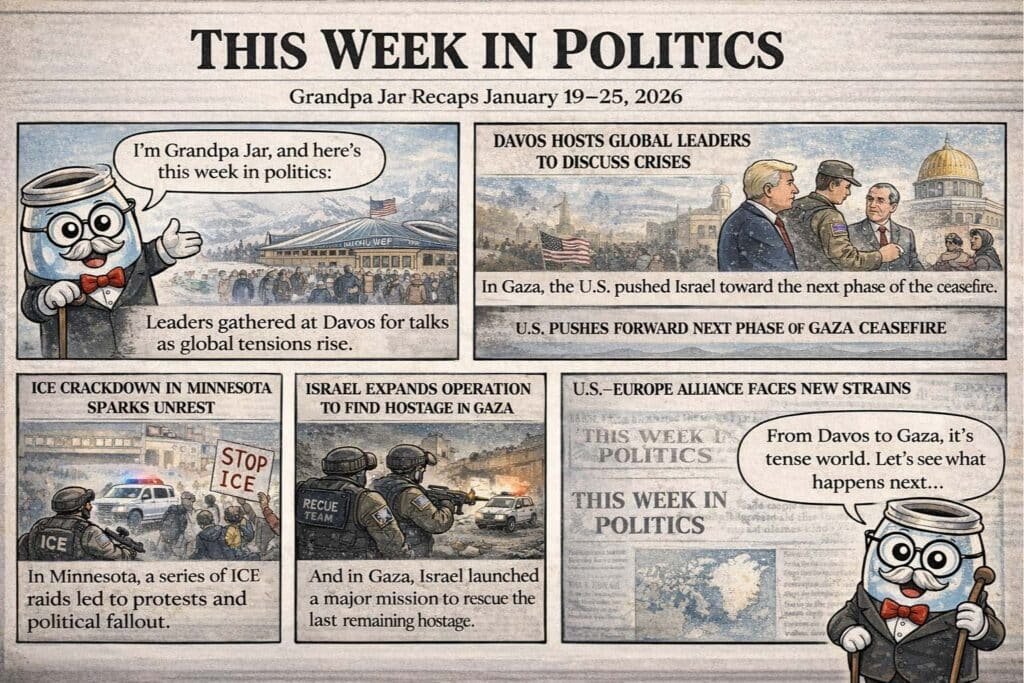
This week, Minnesota became the center of a major political and civic controversy after incidents involving federal immigration enforcement drew widespread public attention. Protests and political reaction escalated as questions mounted over enforcement tactics, transparency, and the use of force in public operations.
The political ramifications are significant because immigration policy is no longer debated only at the border. It is increasingly felt in American cities, neighborhoods, and workplaces. When federal immigration enforcement becomes visible and disruptive, it stops being an abstract policy discussion and becomes a local governance issue—forcing mayors, governors, and federal officials into a high-stakes confrontation over power and responsibility.
The Minnesota controversy also highlights the growing divide between what communities expect from law enforcement and what federal agencies are authorized to do. When video evidence, legal actions, and public demonstrations intersect, the result is more than a headline. It becomes a legitimacy test.
Politically, this creates risk on all sides. Leaders who support stronger immigration enforcement may still face pressure to address questions of oversight and proportionality. Leaders who oppose aggressive enforcement must respond to public anger while also proposing workable policy solutions. With immigration likely to remain one of the most defining issues of the decade, Minnesota could become a blueprint for how the nation debates enforcement in the years ahead.
Davos Opened Under Pressure to “Fix” a Fracturing Global Order
Why It Matters
The World Economic Forum began this week in Davos with an unusually tense global atmosphere. Leaders arrived facing a world shaped by overlapping challenges: war and instability, rising nationalism, economic inequality, trade competition, and public mistrust in institutions.
Davos matters politically because it functions as a high-level collision point between government and private power. It is where leaders attempt to build working relationships, coordinate messaging, and rally support around global priorities that cannot be solved by any one nation—energy security, supply chain stability, and conflict-related disruption.
Still, the broader meaning of Davos in 2026 is that the global system feels less predictable. Instead of operating through stable alliances and shared assumptions, many countries appear to be shifting toward “every nation for itself” decision-making. That trend creates uncertainty that affects ordinary people quickly: higher prices, weakened security partnerships, and slower solutions to humanitarian crises.
Even critics who dislike the elite optics of Davos should recognize its underlying truth: what leaders decide—or fail to decide—often shapes jobs, inflation, trade, and global peace.
Gaza Ceasefire Talks Faced New Strain Amid Diplomatic Tension
Why It Matters
The war in Gaza remained a central international political crisis this week, with U.S. officials pushing for movement toward the next stage of ceasefire planning. The core issue is that ceasefire agreements are rarely “one moment.” They are fragile, multi-stage political processes.
The next phase matters because it is where diplomacy either stabilizes—or collapses. If negotiations stall, humanitarian conditions worsen, regional escalation becomes more likely, and the political cost rises for everyone involved. For Israel’s leadership, it becomes a test of balancing security objectives with global pressure and domestic expectations. For U.S. leadership, it becomes a test of influence: whether Washington can still guide outcomes among its allies in a complex, emotionally charged war.
This week’s developments also showed how global credibility is shaped. If a country says it wants peace but is unable to influence the next steps, that weakness becomes visible to both allies and adversaries.
Israel Expanded Operations Related to Hostage Recovery
Why It Matters
Israel’s government signaled and launched major operations related to locating the last remaining hostage in Gaza. Hostage recovery remains one of the most emotionally powerful drivers of Israeli politics, and it continues to shape the military and diplomatic decisions surrounding the war.
The political weight of hostage recovery is difficult to overstate. These are not simply tactical missions. They become questions of national responsibility and government legitimacy. Every day a hostage remains unrecovered becomes another day that families, communities, and the public demand results.
But large-scale operations also carry serious risks—especially when humanitarian concerns and international scrutiny are already high. They can inflame regional tensions, erode diplomatic momentum, and increase global backlash. This is the cruel political trap of modern conflict: even morally urgent objectives can intensify the very war leaders say they want to end.
UNRWA and Humanitarian Aid Became a Renewed Political Battleground
Why It Matters
The United Nations relief agency UNRWA faced renewed attention and tension this week amid ongoing regional instability. The political battle around UNRWA is not simply about one agency—it reflects a deeper global struggle over who gets trusted to deliver aid, and whether humanitarian institutions can function in war zones without being discredited or attacked.
Humanitarian systems are not optional during conflict—they are infrastructure. When that infrastructure breaks down, civilians suffer immediately: fewer resources, fewer safe spaces, and fewer options for survival. Politically, the collapse of humanitarian trust can accelerate radicalization, fuel instability, and deepen long-term conflict cycles.
This week’s debate reinforces a harsh reality: if the world cannot protect neutral humanitarian operations, it becomes far harder to prevent wars from spiraling into permanent humanitarian disasters.
U.S.–Europe Relations Remained Strained Over Greenland and Alliance Trust
Why It Matters
Tensions linked to President Trump’s continued focus on acquiring Greenland remained part of the global political conversation this week, especially as leaders converged at Davos. The issue has become symbolic of a deeper concern among U.S. allies: whether long-standing partnerships are still guided by shared rules or increasingly shaped by threats and leverage.
Greenland is strategically significant, particularly as Arctic competition increases. But the political ramifications extend far beyond the island itself. NATO’s strength relies on trust and predictability. When an ally appears to challenge sovereignty—or uses trade pressure as a geopolitical weapon—alliances weaken quietly.
Even if no policy changes occur immediately, credibility damage accumulates. Allies begin hedging their security strategies. Adversaries watch closely. And the balance of international influence can shift faster than many people expect.
The White House Announced New Presidential Actions, Including Housing-Related Policy Moves
Why It Matters
This week included official presidential actions, including policy messaging and executive measures connected to national issues such as housing affordability. Housing has become one of the most politically powerful domestic issues because it affects nearly every part of modern life: financial stability, family planning, mobility, and long-term economic confidence.
When presidents address housing, they are not just addressing real estate—they are responding to a public perception that the system is increasingly rigged against ordinary people. Executive actions can signal urgency, but they also create debates about the limits of presidential power and whether long-term solutions require Congress.
The politics of affordability are not going away. Whether future efforts become meaningful reform or symbolic messaging will shape both public trust and voter behavior.
What to Watch For Next
Here are the key developments to monitor coming out of this week:
- Minnesota and federal enforcement: Watch for investigations, court actions, and further political conflict between federal agencies and local officials.
- Public trust and immigration policy: Expect immigration enforcement debates to intensify as more communities experience federal actions directly.
- Davos follow-through: Davos headlines matter less than what leaders do afterward—watch trade decisions, security coordination, and diplomatic shifts.
- Gaza ceasefire durability: The next phase could either expand diplomacy or collapse into renewed escalation.
- Humanitarian agency credibility: Future aid decisions will shape whether international relief systems can function effectively in conflict zones.
- Alliance stability: Greenland-related tensions may continue testing NATO cohesion and Europe’s willingness to confront U.S. pressure.
References
Associated Press. (2026, January 20). Trump puts next steps on Gaza ceasefire plan at risk by antagonizing Europe over Greenland. Associated Press.
Associated Press. (2026, January 24). U.S. officials urge Netanyahu to advance Gaza ceasefire deal. Associated Press.
Associated Press. (2026, January 25). Israel launches large-scale operation to locate last hostage in Gaza. Associated Press.
Reuters. (2026, January 10). Protesters set off fireworks in Minneapolis march after ICE shooting. Reuters.
Reuters. (2026, January 25). Can ICE agents be prosecuted for Minneapolis shootings? Reuters.
The White House. (2026). Presidential actions. The White House. https://www.whitehouse.gov/presidential-actions/
World Economic Forum. (2026, January). Heads of state gathered at Davos 2026. Here’s what they’re saying. World Economic Forum. https://www.weforum.org/
We are on Social Media: Follow Us on X (twitter) and Facebook and Linkedin
We have a new kid friendly section called PJ Explains Politics
Political Jar Editorial Standards and Ethics Policy