
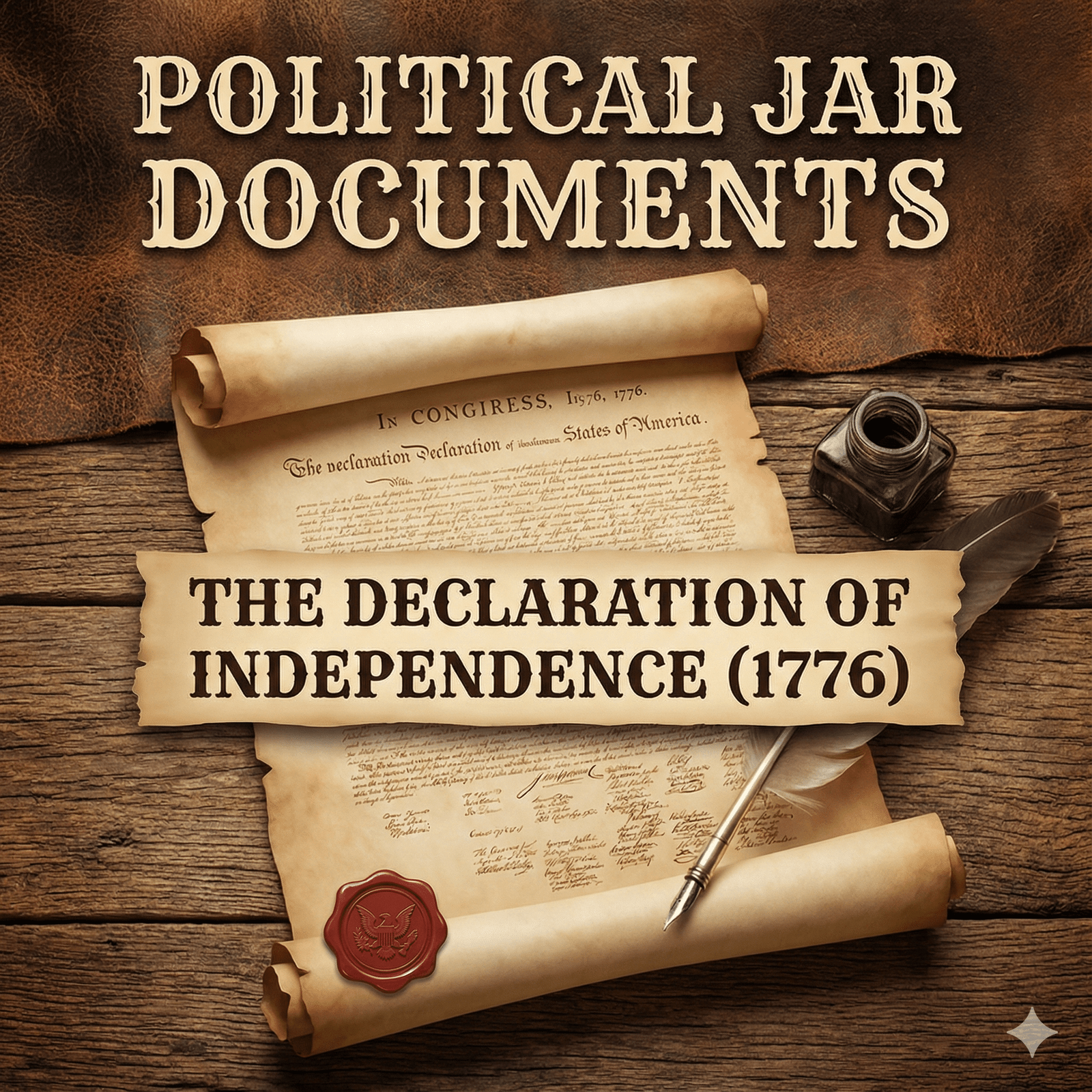
The Declaration of Independence (1776): The Birth Certificate of a Nation
The moral compass of the nation, this document famously declared that all men are created equal and endowed with unalienable rights to life, liberty, and the pursuit of happiness."
Download the Declaration of Independence: America’s Founding Philosophy
Few documents in human history have had the seismic impact of the Declaration of Independence. Adopted by the Second Continental Congress on July 4, 1776, it was more than just a formal break with Great Britain; it was a revolutionary statement of human rights and government by consent.
At Political Jar, we believe that understanding history requires going straight to the source. We are proud to offer a free download of the Declaration of Independence so you can read the exact words that launched the American experiment.
Why This Document Changed the World
Before 1776, the prevailing view held that kings ruled by divine right and subjects owed them allegiance. The Declaration of Independence, primarily drafted by Thomas Jefferson, shattered that paradigm.
It argued that governments are instituted among men not to grant rights, but to secure rights that already exist by nature. When a government becomes destructive of those ends, it is the right of the people to alter or abolish it. This justification for revolution was a radical departure from contemporary political thought and laid the groundwork for modern democracies globally.
Life, Liberty, and the Pursuit of Happiness
The document’s preamble contains perhaps the most potent sentence in American history:
“We hold these truths to be self-evident, that all men are created equal, that they are endowed by their Creator with certain unalienable Rights, that among these are Life, Liberty and the pursuit of Happiness.”
While the United States has often struggled to live up to this lofty ideal, these words have served as the nation’s moral compass for nearly 250 years. They have inspired abolitionists, suffragists, civil rights leaders, and reformers to demand that the promise of America apply to everyone.
Beyond the philosophy, the document serves as a legal indictment of King George III. The list of grievances—ranging from taxation without representation to interfering with justice—provides a fascinating window into the practical reasons why the colonists felt compelled to fight.
Get Your Free Copy of This Essential Founding Document
Don’t rely on summaries or second-hand interpretations. Every citizen, student of history, and political observer should own copies of the nation’s founding documents.
Download the Declaration of Independence for free, courtesy of Political Jar. Add this essential piece of history to your digital library today.
Related Products
Articles of Confederation
America’s first constitution. Ratified in 1781, the Articles established a "firm league of friendship" among sovereign states. It created a intentionally weak central government lacking the power to tax or regulate trade. Download this primary source to understand the critical failures that led directly to the Constitutional Convention of 1787.
Bill of Rights and Senate Mark-up: The Evolution of Freedom
The shield of American liberty—and the draft that forged it. Download the final Bill of Rights alongside the rare Senate Mark-up (1789). See the actual handwritten edits where the Senate debated, condensed, and finalized the specific freedoms you possess today. A unique look at how Congress crafted the Constitution.
The Constitution of the United States
The supreme law of the land. Drafted in 1787, this document established the framework of the U.S. government, creating the separation of powers between the legislative, executive, and judicial branches. Download this essential primary source to understand the foundation of American democracy.
The Monroe Doctrine (1823): America’s Declaration of Global Power
"America for Americans." Delivered by President James Monroe in 1823, this bold foreign policy statement warned European powers that the Western Hemisphere was closed to future colonization. It established the U.S. as the protector of the Americas. Download this foundational text to understand the origin of U.S. dominance in the region.