

This Week in Politics: January 12–18, 2026
Weekly Political News Recap
The third week of January 2026 underscored how rapidly political pressure points can escalate, both at home and abroad. From rising tensions between the United States and its European allies to democratic backsliding in West Africa and continued unrest in Iran, this week’s developments reveal how power, governance, and diplomacy remain deeply interconnected. Below is a comprehensive Political News Recap explaining what happened — and why it matters.
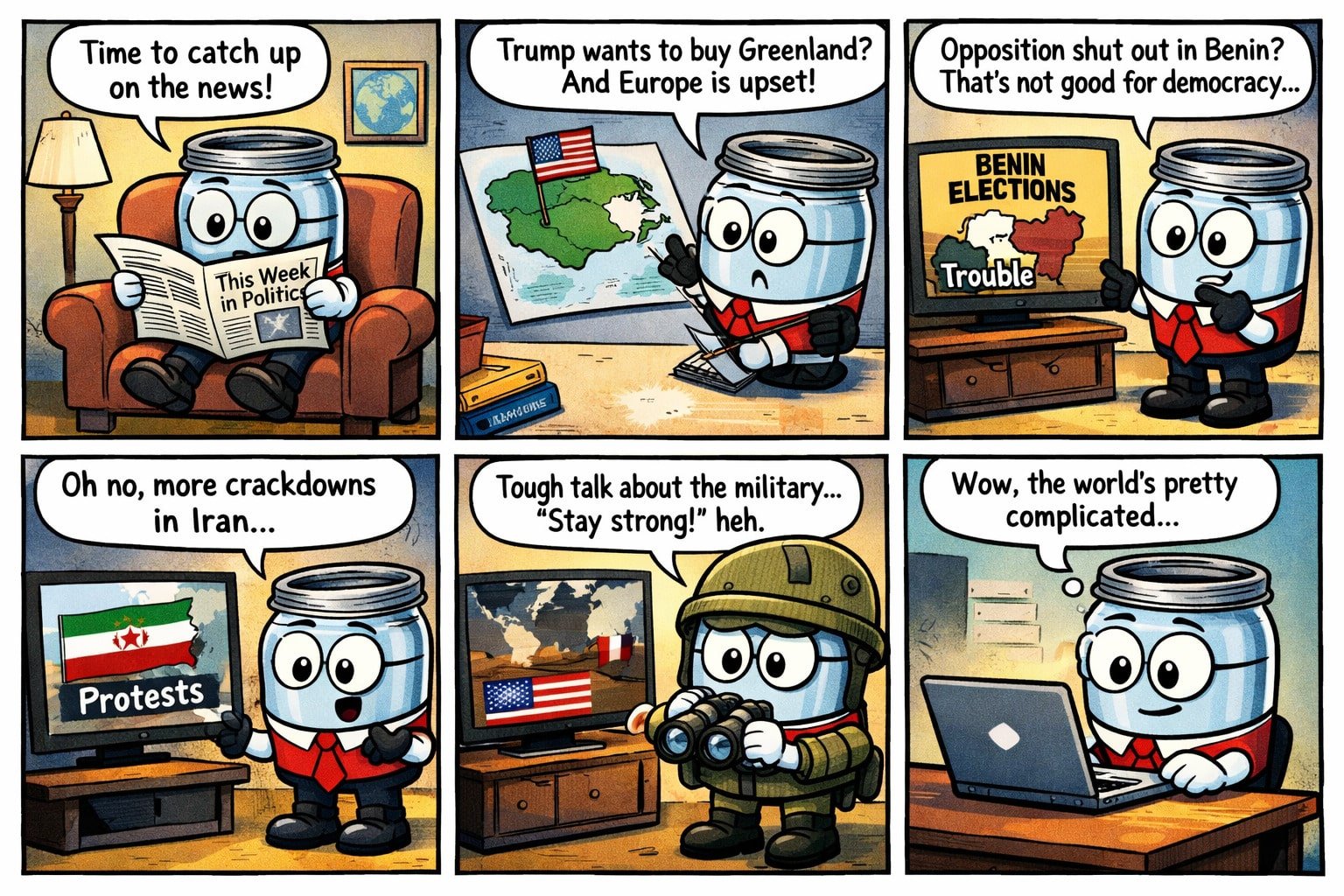
What Happened: U.S.–Europe Tensions Escalate Over Greenland
Why It Matters
President Donald Trump renewed and intensified his long-standing interest in acquiring Greenland, an autonomous territory of Denmark, triggering diplomatic fallout across Europe. This week, the White House linked potential tariffs and economic penalties to European military cooperation in Greenland through NATO exercises. European leaders, including officials from Denmark, Germany, and France, publicly rejected the approach, warning that economic coercion tied to territorial ambitions threatens alliance unity.
Greenland’s strategic value has grown significantly due to Arctic shipping routes, rare-earth mineral deposits, and military positioning. While U.S. interest in the Arctic is not new, the method — leveraging tariffs against allies — represents a sharp departure from post-World War II norms of consensus-driven diplomacy within NATO. European officials framed the issue not merely as a territorial dispute, but as a test of sovereignty and alliance trust.
Public opinion further complicates the strategy. A Reuters-Ipsos poll released this week found that only a small minority of Americans support efforts to acquire Greenland, raising questions about domestic backing for a policy that carries significant diplomatic costs. The episode highlights how economic tools are increasingly used as instruments of geopolitical pressure — even among allies — with long-term implications for transatlantic cooperation.
What Happened: Opposition Shut Out of Benin’s Parliamentary Elections
Why It Matters
Benin’s January 2026 parliamentary elections resulted in a sweeping victory for parties aligned with President Patrice Talon, which secured all 109 seats in the National Assembly. Opposition parties failed to meet electoral thresholds required for representation, leaving the legislature without formal opposition for the second consecutive cycle.
Benin (formerly known as Dahomey) was once regarded as one of West Africa’s most stable democracies. This outcome, however, underscores growing concerns about democratic erosion in the region. When opposition movements are structurally excluded from political participation, governance risks becoming increasingly centralized, weakening accountability and public trust.
The timing is particularly significant. The elections followed a recently thwarted coup attempt, suggesting deeper political tensions beneath the surface. With presidential elections scheduled for later in 2026, international observers and regional organizations are closely monitoring whether Benin’s political system can accommodate dissent without instability. For democracies globally, Benin’s trajectory serves as a cautionary example of how legal frameworks can be used to narrow political competition without overtly suspending elections.
What Happened: Protests and Crackdowns Continue in Iran
Why It Matters
Widespread protests across Iran persisted this week, driven by public anger over economic hardship, political repression, and declining living conditions. Iranian security forces responded with force, leading to reports of thousands of deaths since unrest escalated in late 2025. The demonstrations represent one of the most sustained challenges to the Iranian government in recent years.
Internationally, the unrest has renewed debate over how foreign governments — particularly the United States and European nations — should respond. While some policymakers argue for increased sanctions and diplomatic pressure, others warn that external intervention risks strengthening hardliners within Iran.
Beyond immediate humanitarian concerns, the protests have broader regional implications. Iran plays a central role in Middle Eastern geopolitics, and internal instability affects energy markets, regional proxy conflicts, and nuclear negotiations. The scale and persistence of the demonstrations signal deep structural dissatisfaction that cannot be easily resolved through repression alone.
What Happened: U.S. Leaders Emphasize Military Deterrence Messaging
Why It Matters
American political leaders continued to publicly emphasize military readiness as a tool of deterrence, with several Republican lawmakers arguing that the credible threat of force sends a clear message to adversaries abroad. These statements coincided with broader debates about U.S. involvement in global conflicts and the balance between diplomacy and military power.
Rhetoric matters in international relations. Statements made by U.S. officials are closely monitored by allies and adversaries alike, shaping perceptions of American resolve and intentions. While deterrence can prevent conflict, heightened rhetoric also carries escalation risks if not paired with diplomatic engagement.
As the United States navigates multiple global flashpoints, this week’s messaging reflects an ongoing tension in U.S. foreign policy: projecting strength while avoiding unnecessary confrontation. How this balance is managed will influence global stability well beyond 2026.
What to Watch For
- NATO and Arctic Policy: Whether diplomatic efforts can de-escalate U.S.–European tensions over Greenland and Arctic security.
- Benin’s Presidential Election: Signs of political inclusion or further consolidation of power ahead of the 2026 vote.
- Iran’s Internal Stability: Potential shifts in protest momentum, government response, or international diplomatic engagement.
- U.S. Foreign Policy Signals: How military rhetoric and economic pressure tools evolve as global tensions persist.
References
Reuters. (2026, January 14). Just one in five Americans support Trump’s efforts to acquire Greenland, Reuters/Ipsos poll finds.
Reuters. (2026, January 18). European leaders warn Trump’s Greenland push risks NATO unity.
Associated Press. (2026, January 18). Opposition loses all seats in Benin parliamentary election following disputed reforms.
Associated Press. (2026, January 16). Iran protests continue amid deadly crackdowns.
12NewsNow. (2026, January 18). Lawmakers debate U.S. military deterrence and global messaging.
To learn how your elected officials vote: visit the Political Jar Political Directory
Connect with us on X at PoliticalJarX
Political Jar Editorial Standards and Ethics Policy
