H.R. 555 Explained: How the ‘Digital Safety Act’ Actually Changes Your Internet Privacy (In Plain English)
It seems that digital law changes every few days and few pieces of legislation have sparked as much conversation as H.R. 555, often referred to as the Digital Safety Act. As we navigate the end of 2025, this bill represents a significant shift in how the federal government approaches your personal data and the “wild west” of the internet that some people love, while others simply detest.
For years, the United States has relied on a patchwork of state laws and narrow federal rules to protect users. H.R. 555 aims to change that by introducing a uniform standard for digital privacy, specifically targeting the ways companies collect, share, and profit from your online life.
The End of “Hidden” Tracking
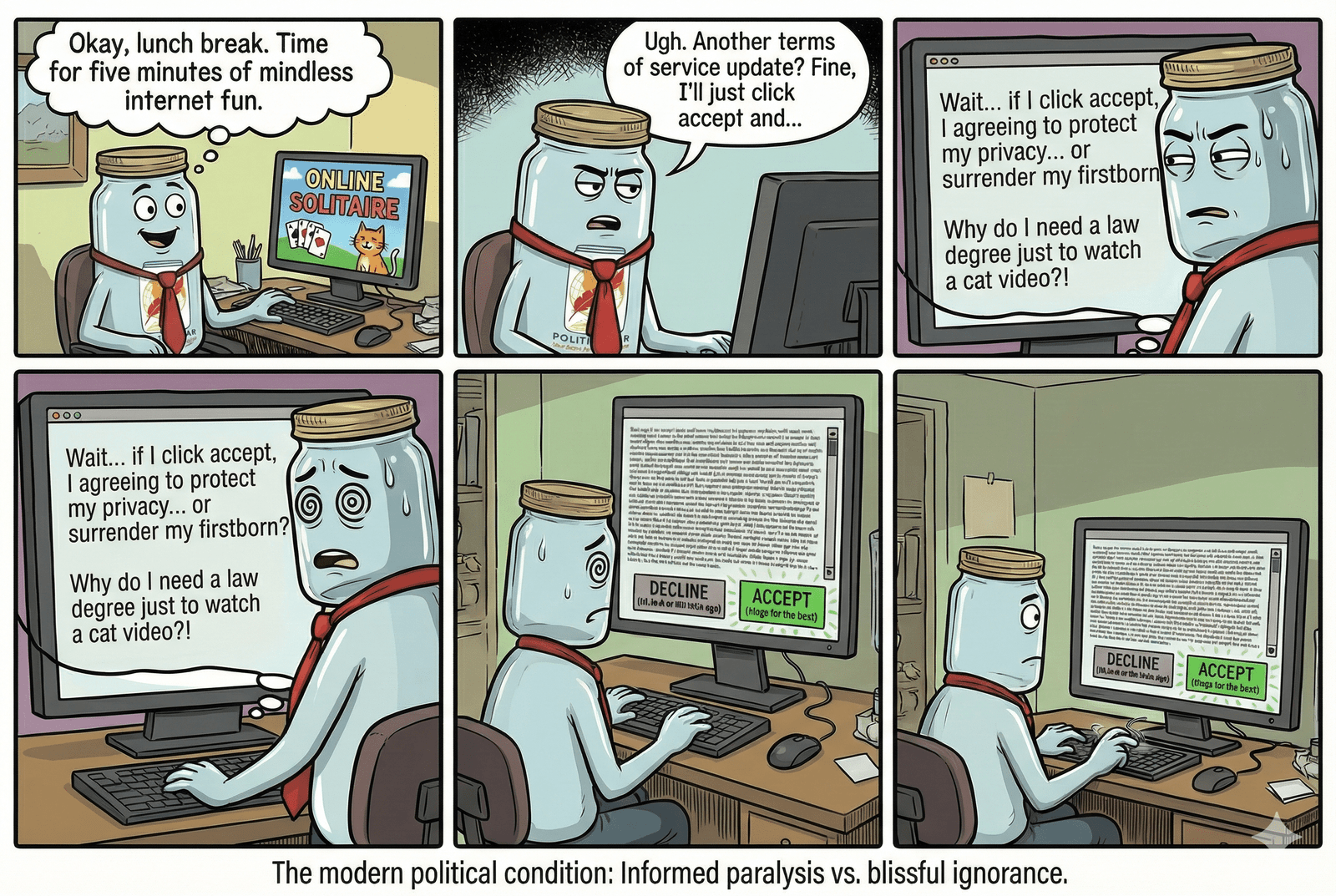
One of the most immediate changes you will notice under the Digital Safety Act is the death of the “invisible tracker.” Currently, many websites use “dark patterns”—manipulative design choices like the one PJ’s older brother faced in our cartoon—to trick you into consenting to data collection.
H.R. 555 mandates that privacy options must be clear and equally visible. If there is a big green “Accept” button, there must be an equally accessible “Decline” button. It moves the burden from you, the user, to the company, requiring them to prove that you gave “informed consent” rather than just clicking through a wall of legal jargon.
A “Duty of Care” for Minor Users
A major pillar of H.R. 555 is the protection of children and teenagers. Taking a cue from recent bipartisan efforts like the Kids Online Safety Act (KOSA), H.R. 555 establishes a legal “duty of care” for social media platforms.
This means platforms are now legally responsible for preventing their algorithms from pushing harmful content—such as material promoting eating disorders or self-harm—to minors. For a high school senior, this might mean seeing fewer “addictive” features designed to keep you scrolling late into the night, as the bill restricts notifications during late-night hours for underage accounts.
Data Minimization: Less is More
The Act introduces the principle of “data minimization.” In the past, an app might ask for your location, your contacts, and your microphone access just to let you play a simple game. Under H.R. 555, companies can only collect the data that is strictly necessary for the app to function. Once that data is no longer needed, they are required to delete it rather than storing it indefinitely in a digital vault.
Why This Matters for You
While critics argue that these regulations might make some free services harder to find or increase costs for small businesses, proponents argue the trade-off is worth it for our collective security. By providing a federal baseline, H.R. 555 ensures that whether you are in California or Kansas, your “right to be forgotten” and your right to know who is buying your data are protected by the same set of rules.
References
- Blumenthal, R. (2025). Kids Online Safety Act (KOSA) Summary. U.S. Senate.
- European Commission. (2025). Digital Services Act: Keeping us safe online.
- Federal Register. (2025). Preventing Access to U.S. Sensitive Personal Data by Countries of Concern.
- U.S. House of Representatives. (2025). H.R. 555: Digital Safety and Transparency Act of 2025.
- U.S. Privacy Update. (2025). Where Things Stand at the Start of Q2 2025. Paul Hastings LLP.
To see how your representative voted on H.R. 555 Please visit the Political Jar Political Directory