This Week in Politics: March 1–7, 2026 – Weekly Political News Recap
From the escalating US–Iran war to prisoner swaps in Ukraine and youth-driven change in Nepal, this week in politics reshaped fault lines across every major region. This weekly political news recap for March 1–7, 2026 highlights the key stories and why they matter for voters, markets, and global security.
US–Iran War Escalates
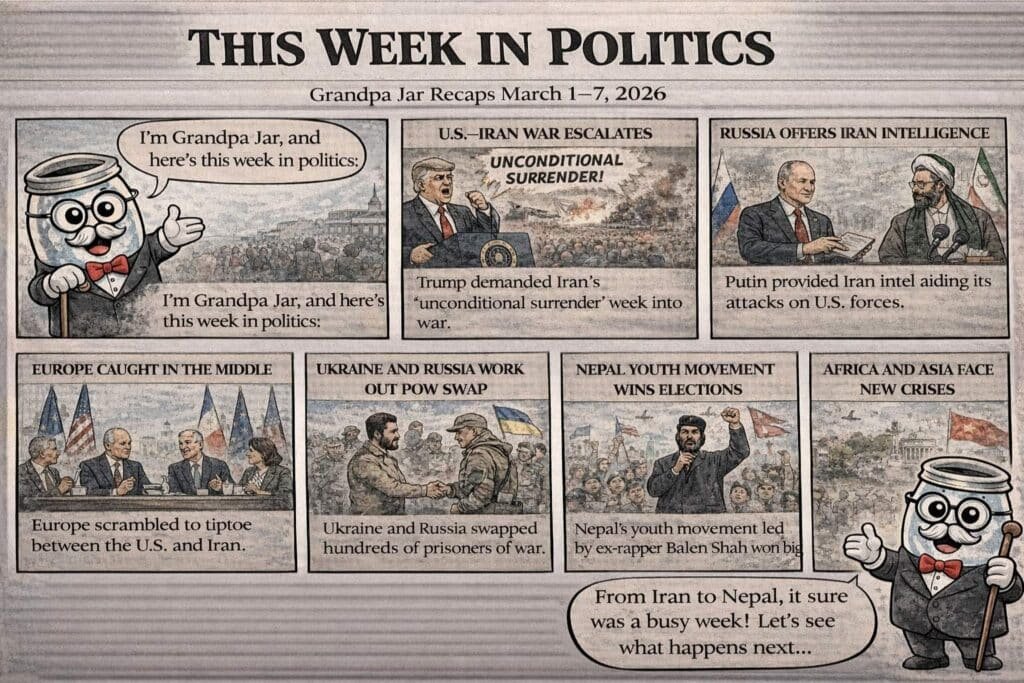
The News. Nearly a week into joint US–Israeli strikes on Iran, President Donald Trump publicly set “unconditional surrender” as Washington’s war aim, saying he would accept nothing less from Tehran. In social media posts and interviews, he vowed there would be “no deal with Iran except UNCONDITIONAL SURRENDER,” tying any end to the campaign to the destruction of Iran’s military capabilities and the later selection of “great and acceptable” new leaders. The statement came after a US–Israeli operation killed Supreme Leader Ayatollah Ali Khamenei and other senior commanders, triggering Iranian missile and drone attacks on US bases and regional targets.
Why It Matters. By defining victory as Iran’s unconditional surrender, the White House has sharply narrowed room for diplomacy and signaled a potentially long, grinding conflict with open-ended goals. The war is already roiling oil markets, closing or constraining key waterways like the Strait of Hormuz, and driving up fuel prices, with ripple effects on inflation and interest rates worldwide. For ordinary people, that can mean higher costs at the pump, more volatile markets, and heightened security concerns at home as governments raise alert levels in response to Iranian threats of retaliation.
Russia Backs Iran With Intelligence
The News. US and allied intelligence assessments revealed that Russia is providing Iran with satellite imagery and other intelligence on the locations and movements of American troops, warships, aircraft, and critical infrastructure in the Middle East. Officials say the information has helped Iran more precisely target US radar, communications, and command-and-control sites during its recent wave of missile and drone attacks, although there is no proof Moscow is directly guiding specific strikes. Reports suggest this assistance began after the initial US–Israeli strikes on Iran and represents a “comprehensive effort” by Russia to bolster Tehran’s wartime capabilities.
Why It Matters. Russia’s intelligence support deepens the emerging Moscow–Tehran axis and effectively turns the Iran war into another arena of indirect confrontation between Russia and the United States. This raises the risk of miscalculation, with Russian and American assets operating in the same crowded region while Moscow helps Tehran go after sensitive US targets. For readers, it underscores how regional wars can quickly entangle great powers, with consequences for NATO–Russia tensions, sanctions policy, and the broader stability of global energy and shipping routes.
Europe Walks the Iran Tightrope
The News. European governments spent the week scrambling to respond to the US–Israeli attack on Iran, stressing they did not participate in the initial strikes while trying to avoid a full rupture with Washington. Germany convened emergency meetings and the EU began evacuating some personnel from the region, while France, Germany, and the UK issued a joint statement urging Iran to halt its nuclear and regional activities but stopping short of openly endorsing the bombing campaign. Spain’s prime minister went further, refusing US use of shared bases for offensive operations and warning that Trump’s threats of a total trade embargo were “playing Russian roulette with the destiny of millions,” drawing support from other EU leaders.
Why It Matters. Europe’s cautious, fragmented response highlights how strained transatlantic ties have become under Trump’s second term and how little leverage many European capitals feel they have over US war decisions. The debate is also domestic: leaders must balance alliance commitments with public memories of the Iraq war and fears of being dragged into another unpopular Middle East conflict. For Europeans, this could shape everything from energy prices and refugee flows to the debate over building a more autonomous EU security posture that is less dependent on Washington.
Ukraine POW Swap and Frontline Visit
The News. Ukraine and Russia completed their largest prisoner exchange in months, swapping 500 soldiers each over two days, with the United States and United Arab Emirates mediating the deal. On March 6, President Volodymyr Zelensky visited frontline units near Druzhkivka and Kostiantynivka in the eastern Donetsk region, awarding medals as Russian forces mass for a spring offensive. The swap also returned two Ukrainian civilians and followed earlier Geneva talks that are among the few tangible diplomatic outcomes since the war’s third anniversary.
Why It Matters. The exchange offers a rare humanitarian bright spot in a grinding war, providing relief to hundreds of families while building limited trust for future negotiations. Zelensky’s trip to the front is meant to boost troop morale and signal that Ukraine will keep fighting even as it engages in diplomacy under pressure from Washington and other mediators. For citizens outside the region, the deal is a reminder that the Ukraine conflict remains active and intertwined with wider great-power bargaining—even as attention shifts to the Iran war.
Nepal’s Youthquake Election
The News. Nepal held a pivotal general election this week, the first since Gen Z–led protests last year forced the prime minister to resign after a deadly crackdown that killed at least 77 people. Early reporting and unofficial tallies show the anti-establishment Rastriya Swatantra Party (RSP), fronted by former rapper and Kathmandu ex-mayor Balendra (Balen) Shah, leading decisively in many constituencies against long-dominant parties. Turnout surpassed 50 percent by mid-afternoon on voting day, with young voters prioritizing jobs, corruption, and basic services.
Why It Matters. If confirmed, a strong RSP performance would mark a major generational and political realignment in a country long governed by the same small circle of party elites. A youth-driven mandate could accelerate reforms on governance, infrastructure, and employment—but could also face resistance from entrenched interests and a fragmented parliament. For other democracies, Nepal’s election illustrates how frustration with corruption and stagnation can rapidly translate into electoral disruption when a charismatic outsider channels youth anger.
Africa’s Fragile Security Moment
The News. In South Sudan’s Ruweng region, armed groups carried out one of the deadliest single attacks in years, killing around 169 people—including about 90 civilians and dozens of soldiers—in coordinated assaults on Abiemnhom County. Authorities buried victims in mass graves, more than 1,000 people fled to a UN base for protection, and observers warned the 2018 peace agreement is now “functionally dead” as violence displaces hundreds of thousands since December. At the same time, Uganda’s Supreme Court confirmed President Yoweri Museveni’s controversial seventh-term victory after opposition petitions were withdrawn, with key rival Bobi Wine reportedly under house arrest and turnout at a post-1980s low.
Why It Matters. The Ruweng massacre underscores how quickly African peace deals can unravel when underlying power-sharing, security, and accountability issues remain unresolved. Uganda’s contested election result and ongoing repression highlight a broader regional pattern in which aging leaders entrench themselves, raising the risk of future instability despite short-term “order.” Coupled with an Iran-war-driven oil price shock that threatens to derail planned interest-rate cuts across Africa, these crises may squeeze public finances and worsen living conditions for millions.
Asia’s High-Stakes Political Week
The News. China opened its annual “Two Sessions” meetings in Beijing, where the National People’s Congress and top advisory body are expected to endorse a new Five-Year Plan focused on slower but “higher-quality” growth, technological self-reliance, and stronger domestic demand. Beijing signaled deeper integration of Hong Kong into mainland planning as a vice premier urged local elites to strengthen “executive-led governance” and national security vigilance. Elsewhere in Asia, Indonesia’s President Prabowo Subianto and Pakistan’s Prime Minister Shehbaz Sharif discussed a joint visit to Tehran to urge restraint after the US–Israeli strikes, while Prabowo warned Indonesia could quit a US-backed Gaza peace forum if it fails to advance Palestinian statehood.
Why It Matters. China’s 2026 Two Sessions formalize a shift toward resilience over raw growth, with big implications for global supply chains, export markets, and Southeast Asian economies increasingly serving as “nearshore” production hubs for Chinese industry. Moves to tighten political control and security in Hong Kong show Beijing will continue prioritizing stability and national security over liberalization, affecting business confidence and civil freedoms. Meanwhile, Indonesian and Pakistani diplomacy around Iran underscores how middle powers in Asia are seeking room to maneuver between Washington, Tehran, and Beijing, shaping outcomes on energy flows and regional conflict management.
Latin America’s Election Countdown
The News. Colombia entered the final stretch before a “triple ballot” on March 8 that combines legislative elections and three coalition presidential primaries, widely billed as the country’s most consequential vote in a decade. Polls suggest President Gustavo Petro’s left-wing Historic Pact will face a fragmented but energized right, with far‑right lawyer Abelardo de la Espriella leading early presidential surveys even as many conservatives worry he could lose a runoff to a leftist rival. Across the region, analysts note that Colombia’s contests will set the tone for a crowded 2026 election calendar that also includes Brazil, Peru, Costa Rica, and Haiti.
Why It Matters. Sunday’s results will determine whether Petro can salvage parts of his agenda on tax, health, and the peace process, or instead spend his final 18 months blocked by a hostile Congress. The primaries will also clarify whether Colombia moves toward a harder right, a renewed left, or continued fragmentation—each path carrying different implications for security policy, foreign investment, and relations with Washington. For Latin Americans more broadly, Colombia’s vote is an early test of whether the region continues its recent leftward drift or begins a new right-leaning cycle amid economic anxiety and crime.
Final Summary
Across March 1–7, 2026, global politics were defined by escalation in the US–Iran war, deepening great‑power competition, and a flurry of elections and institutional shifts from Nepal to Colombia. For readers trying to understand how this week in politics affects them, the common threads are higher geopolitical risk, potential energy and cost‑of‑living shocks, and a growing struggle between entrenched establishments and impatient electorates demanding change.
References
Al Jazeera. (2026, March 6). Zelenskyy visits front line as Ukraine and Russia swap 500 prisoners each.
Asia Society Policy Institute. (2026, February 22). What to watch at China’s Two Sessions in 2026.
Bhandari, G. (2026, March 4). Nepal votes in election pitting entrenched old guard against a powerful youth movement. The Guardian.
CNN. (2026, March 6). Russia is aiding Iran’s war effort by providing intel on US military.
GoLocalProv. (2026, March 6). 5 big news stories overnight – Saturday March 7, 2026.
Military Times. (2026, March 5). Russia provided Iran with information that can help Tehran strike US military, sources say.
NBC News. (2026, March 6). Russia is providing intelligence to Iran on the location of U.S. forces, sources say.
NPR. (2026, February 28). Here’s how world leaders are reacting to the US–Israel strikes on Iran.
Rio Times. (2026, March 2). Africa intelligence brief for Tuesday, March 3, 2026.
Rio Times. (2026, March 3). Latin American pulse for Wednesday, March 4, 2026.
RSIS. (2026, March 5). China’s 2026 Two Sessions and implications for Southeast Asia.
The Associated Press. (2026, February 28). Europeans cautious as they scramble to digest major US and Israeli attack on Iran.
The Globe and Mail. (2026, March 4). European leaders vary in support of U.S.–Israel military strikes on Iran.
The New York Times. (2026, March 7). Russia is sharing intelligence with Iran, U.S. officials say.
The New York Times. (2026, March 7). Trump demands “unconditional surrender” by Iran, shifting U.S. war aims.
The Rio Times. (2026, March 2). Africa intelligence brief for Tuesday, March 3, 2026.
The Washington Post. (2026, March 1). Wary of wider conflict, European allies stress they didn’t join Iran strikes.
Washington Post. (2026, March 3). China to unveil priorities for coming 5 years at major annual political meeting.
Reuters. (2026, March 6). Zelenskiy visits eastern front as Ukraine and Russia exchange POWs.
The Asia Cable. (2026, March 5). Asia Daily: March 6, 2026.
AmaniaAfrica. (2026, January 13). The gathering storm facing Africa in 2026: Entrenching conflicts, fractured order and eroding agency.
International Crisis Group. (2026, February 9). Seven peace and security priorities for Africa in 2026.
AS/COA. (2026, February 25). A guide to 2026 Latin American elections.
Latinvex. (2026, February 4). Latin America 2026: The political outlook.
Follow Political Jar on X (Twitter), Facebook and YouTube
Have kids? Lean as PJ Explains Politics