

This Week in Politics: December 21st – December 27th, 2025 – Weekly Political News Recap
The final full week of 2025 was hardly a quiet holiday break in Washington. From a major legal challenge over the future of artificial intelligence to economic anxieties at the grocery store and renewed trade tensions (this seems to be a continuing theme this year), the political landscape remained active. Below is a breakdown of the key events that shaped the week and their potential significance for the new year.
States Sue Over AI Executive Order
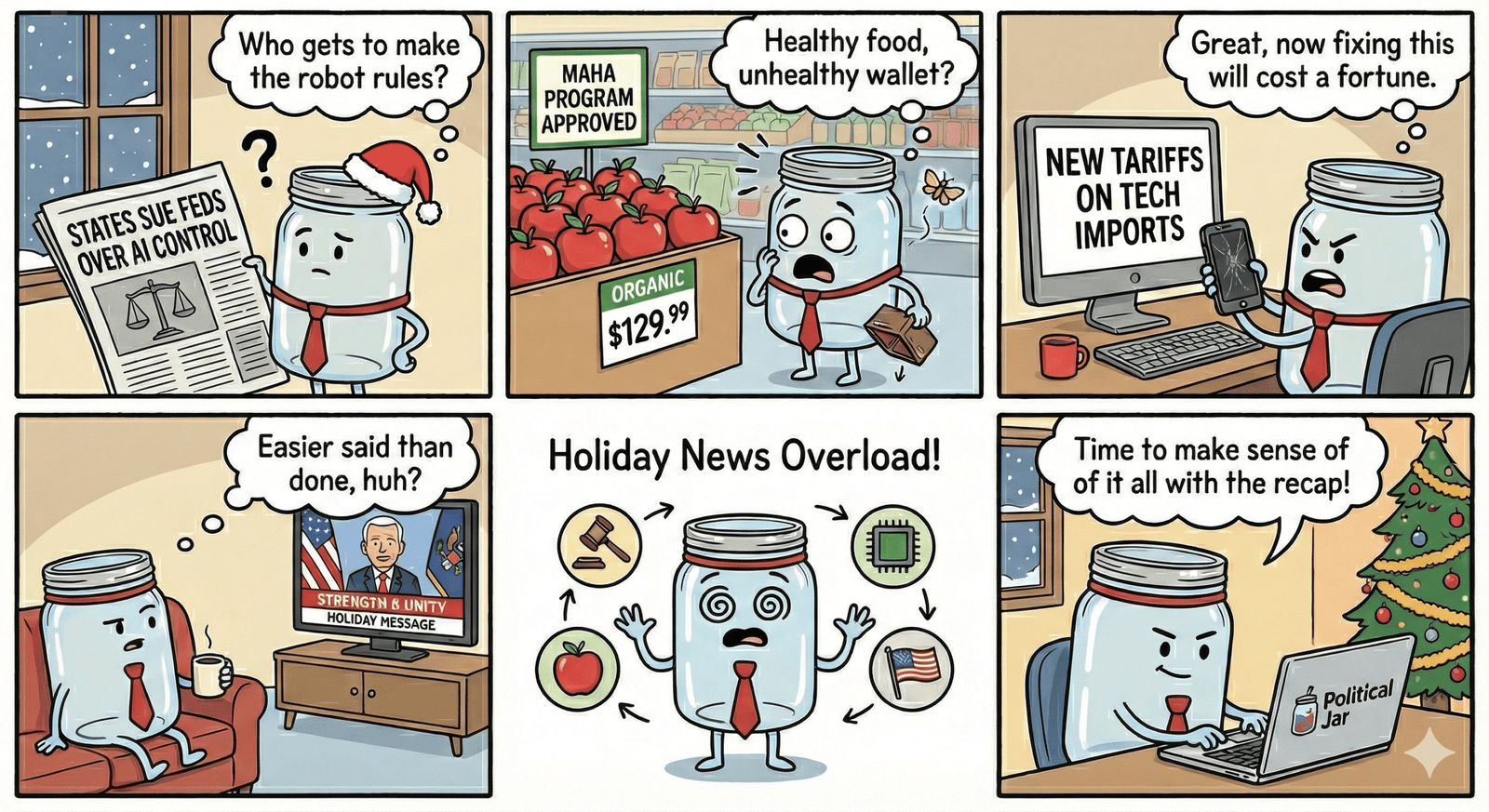
What Happened On Monday, a coalition of 12 states, led by California and New York, filed a lawsuit in federal court challenging the administration’s recent executive order that preempts state-level artificial intelligence regulations. The states argue that the order exceeds presidential authority and unconstitutionally infringes on their right to enact legislation that protects their citizens from potential harms of AI, such as algorithmic bias and data privacy violations.
Why it Matters This legal battle is a modern federalist showdown with immense implications for the future of technology. At its core, it’s a question of who gets to set the rules for the most powerful new technology of our time. The administration favors a single, national standard to foster innovation and maintain global competitiveness, a stance backed by many large tech companies. The states, however, fear a federal standard will be a “race to the bottom,” weakening consumer protections. For the average person, the outcome of this case could determine everything from how your data is handled to whether you have legal recourse if an AI algorithm discriminates against you in a job application or loan request.
“MAHA” Farm Program Faces Consumer Backlash
What Happened The rollout of the new “Regenerative Pilot Program,” a cornerstone of the “Make America Healthy Again” (MAHA) agriculture agenda, faced its first major wave of criticism this week. Consumer advocacy groups and some economic analysts warned that the program’s new production standards and supply chain adjustments could lead to a short-term spike in food prices, just as families were preparing for holiday meals.
Why it Matters This situation highlights the complex reality of implementing major policy shifts, even ones with popular goals. While the long-term objectives of improving soil health and the nutritional quality of food are widely supported, the transition away from established industrial farming practices carries immediate economic risks. For consumers and of course, Political Jar readers like yourself, this is a pocketbook issue. It raises difficult questions about who should bear the financial burden of transforming the food system—farmers, taxpayers, or families at the grocery store checkout line. The backlash suggests the administration may need to do more to mitigate the immediate costs for consumers to maintain public support for the program.
New Trade Tariffs Announced on Select Tech Imports
What Happened On December 23rd, the Office of the U.S. Trade Representative announced it would impose new tariffs on a specific list of technology components imported from China, citing ongoing concerns over intellectual property rights and unfair trade practices. The move was met with an immediate threat of retaliatory measures from Beijing, reigniting fears of a renewed trade war between the world’s two largest economies.
Why it Matters While framed as a necessary step to protect American industries and national security, tariffs almost always have a direct impact on consumers. Companies that import these components face higher costs, which they typically pass on to buyers in the form of higher prices for electronics and other goods. For American businesses that rely on these global supply chains, the announcement brings a new wave of uncertainty and disruption. Politically, it signals a continued commitment to a hawkish stance on trade, a policy that appeals to a specific political base but carries the risk of broader economic fallout that could affect everyone.
Presidential Holiday Message Emphasizes National Unity and Strength
What Happened In his annual Christmas broadcast to the nation, the President delivered a message that sought to balance themes of national unity and reconciliation with an emphasis on American strength and resolve. He touted the year’s legislative achievements and called for a lowering of the partisan temperature in Washington, while also stressing the importance of a robust military and a vigilant national defense posture.
Why it Matters Holiday messages from the president are often largely symbolic, but their tone and content can offer valuable insights into the administration’s priorities and political strategy. By weaving together a call for domestic unity with a focus on strength, the President appears to be attempting a difficult political balancing act: appealing to a broad spectrum of Americans exhausted by division while simultaneously reassuring his core supporters of his commitment to a “strong America” agenda. For citizens, it’s a moment to gauge the rhetorical direction of the country’s leadership as it heads into a new year.
Looking Ahead: What to Watch
- Legal Timelines on AI Case: Watch for the court’s initial schedule in the multi-state lawsuit against the AI executive order. A request for a preliminary injunction could halt the order’s implementation, creating immediate regulatory chaos.
- Grocery Price Monitoring: Keep an eye on the Consumer Price Index (CPI) reports in the coming months for any signs of food price inflation linked to the new agricultural policies.
- China’s Retaliation: The specifics of China’s counter-tariffs will be crucial. Will they target politically sensitive U.S. agricultural exports, as they have in the past, or focus on other sectors?
- Congressional Agenda: As Congress returns in January, observe whether the President’s call for unity translates into any bipartisan legislative initiatives, particularly on issues like infrastructure or data privacy.
References
- American Farm Bureau Federation. (2025, December 24). Statement on the Potential Economic Impacts of the Regenerative Pilot Program.
- National Association of Attorneys General. (2025, December 22). Bipartisan Coalition of States Challenges Federal Preemption of State AI Laws.
- Office of the U.S. Trade Representative. (2025, December 23). Press Release: United States Imposes Tariffs on Certain Technology Imports from China to Protect National Security and Intellectual Property.
- The White House. (2025, December 25). Remarks by President Donald J. Trump in Christmas Broadcast to the Nation.
- U.S. District Court for the Northern District of California. (2025). State of California et al. v. Biden et al., Case No. 3:25-cv-01234.
To see how your representative votes on issues that matter to you, visit the Political Jar Political Directory
