This Week in Politics: March 9–15, 2026 – Weekly Political News Recap
From an escalating U.S.–Israeli war with Iran to bitter voting‑rights fights in Washington and a youth‑driven upset in Nepal, this week’s global political news reshaped both geopolitics and domestic debates.
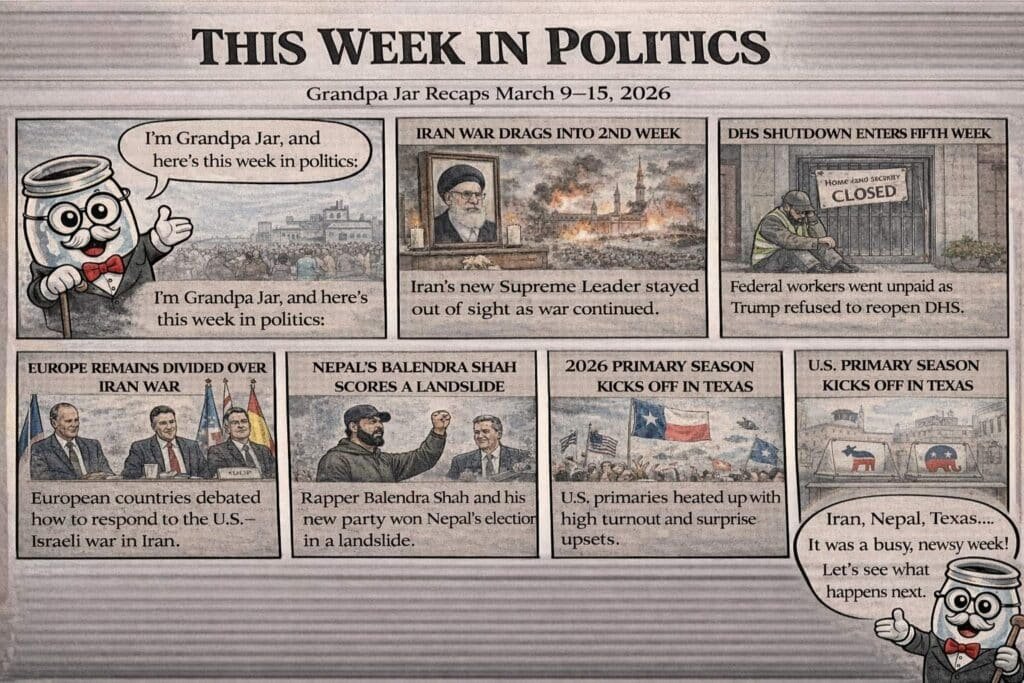
Iran War Enters Second Week as New Supreme Leader Stays Out of Sight
The News
The U.S.–Israeli air campaign against Iran, launched with massive strikes on February 28 that killed Supreme Leader Ayatollah Ali Khamenei, moved into its second week with no clear off‑ramp in sight.
Iran’s leadership named Khamenei’s son, Ayatollah Mojtaba Khamenei, as the new supreme leader, portraying him as a harder‑line figure taking power amid widespread destruction of military infrastructure and government sites.
Iranian state media carried Mojtaba Khamenei’s first written statement insisting the Strait of Hormuz must remain effectively shut to oil exports, even as U.S. and allied officials said he had been wounded in early strikes and has yet to appear publicly.
U.S. and Israeli forces continued intensive air operations, while Iran and its regional proxies hit U.S. bases and Gulf infrastructure, contributing to at least hundreds of deaths inside Iran and dozens more in neighboring countries, according to regional tallies.
Global markets have reacted sharply: Brent crude briefly jumped above the low‑80‑dollar range, up more than 10 percent since the strikes began, and analysts warned a sustained disruption at Hormuz—where about one‑fifth of the world’s seaborne oil normally passes—could push prices toward triple digits.
Stock markets from Europe to Asia traded lower, and safe‑haven assets like gold and the U.S. dollar rose on fears of renewed inflation and a hit to already fragile growth.
Why It Matters
The war is rapidly becoming the most consequential Middle East conflict in years, combining regime‑change rhetoric with direct great‑power involvement and raising the risk of miscalculation across the region.
With Iran threatening to keep the Strait of Hormuz effectively closed and senior Revolutionary Guard figures vowing to stop tanker traffic, households worldwide face higher fuel and food prices as shipping delays and energy costs ripple through supply chains.
For voters in oil‑importing countries, everything from commuting costs to grocery bills could rise if the conflict drags on into the northern summer, complicating central‑bank efforts to tame inflation.
Politically, U.S. President Donald Trump has framed the offensive as a historic move to “eliminate” the Iranian regime’s nuclear and regional threat, while critics in the United States and abroad question the strategy, endgame, and legality of the campaign.
Inside Iran, the opaque condition of Mojtaba Khamenei and the unprecedented assassination of a sitting supreme leader are testing the resilience of the Islamic Republic’s power structure, with analysts debating whether real authority now lies with the Revolutionary Guard and security chiefs rather than the formal leader.
Trump’s SAVE America Act Showdown and Prolonged DHS Shutdown
The News
In Washington, D.C., Donald Trump has escalated his push for the Safeguard American Voter Eligibility (SAVE America) Act, a sweeping federal voting law he calls his top legislative priority ahead of the 2026 midterm elections.
Trump publicly vowed he would not sign “any” bills until Congress passes the SAVE America Act and has urged Senate Republicans to scrap or weaken the 60‑vote filibuster so the GOP can push the measure through without Democratic support.
The Republican‑controlled House has already passed versions of the bill, but it remains stalled in the Senate, where GOP Majority Leader John Thune has so far resisted demands to end the filibuster despite intense pressure from Trump.
Democrats have denounced the SAVE America Act as a voter‑suppression package—some calling it “Jim Crow 2.0”—and say they will not supply the votes needed to advance it.
The standoff is unfolding against the backdrop of a partial federal government shutdown that has left the Department of Homeland Security (DHS) unfunded for a fourth week after a stopgap funding deal collapsed amid disputes over immigration enforcement and election provisions.
While the House is in recess, the Senate is juggling the stalled voting bill, confirmation of Lt. Gen. Joshua Rudd to lead the National Security Agency and U.S. Cyber Command, and a bipartisan housing package known as the 21st Century Road to Housing Act.
Why It Matters
For U.S. voters, the outcome of the SAVE America Act fight could shape who can easily register and cast a ballot in 2026 and beyond, especially in communities that have historically faced barriers to voting.
Because Trump has tied all other legislation to passage of the bill, routine government business—from budget negotiations to bipartisan policy items—faces heightened risk of gridlock.
The ongoing DHS shutdown carries real‑world consequences: airport security, immigration courts, border operations, and key cybersecurity functions are being strained as workers face uncertainty and delayed pay, even as the Iran war raises the overall security threat level.
Politically, Trump’s insistence on tightening voting rules while amplifying unsubstantiated claims of past election fraud is energizing both his base and voting‑rights groups, setting up elections as a central fault line of the 2026 midterm campaign.
Europe Struggles for a Unified Response to the Iran War
The News
European governments spent the week grappling with how to respond to the U.S.–Israeli war on Iran, highlighting deep divisions inside the European Union and NATO.
Spain has taken one of the strongest stances, expelling U.S. military aircraft from its bases and refusing to allow them to be used for operations against Iran, even after Trump threatened to “cut off” economic ties.
Germany’s government, led by Chancellor Friedrich Merz, has aligned more closely with Washington, calling Iran’s leadership a “terrorist regime” and signaling broad support for U.S. objectives even as legal experts there question aspects of the campaign under international law.
In the United Kingdom, Prime Minister Keir Starmer authorized the U.S. to use Britain’s base at Akrotiri in Cyprus for what London describes as “strictly defensive” missions to intercept Iranian missiles, while insisting the UK is not a direct participant in offensive strikes.
At the EU level, Commission President Ursula von der Leyen and other senior officials have pushed for de‑escalation and a negotiated path that includes a “credible transition” for Iran, an end to its nuclear and missile programs, and limits on destabilizing regional activities.
Why It Matters
For European citizens, the Iran war is not an abstract crisis: it threatens higher energy prices, new refugee flows, and the possibility of Iranian or proxy attacks on European assets if the conflict widens.
The split between countries like Spain, which are openly critical of the strikes, and those like Germany and the UK, which are more supportive, exposes long‑running tensions over how much Europe should align with U.S. military strategy versus pursuing its own security doctrine.
These divisions complicate efforts to present a united European front on sanctions, defense spending, and diplomacy at a moment when the EU is already strained by Russia’s war in Ukraine and debates about its role in global security.
Voters across Europe may see the Iran crisis influence domestic debates over hosting U.S. bases, increasing defense budgets, and balancing energy security with foreign‑policy principles.
Youthquake in Nepal: Balendra Shah’s Party Wins Landslide
The News
In South Asia, final results from Nepal’s snap general election held on March 5 confirmed a stunning landslide for the upstart Rastriya Swatantra Party (RSP), led by rapper and former Kathmandu mayor Balendra Shah.
The party secured a clear majority in parliament, winning far more constituencies than any rival and unseating several heavyweight figures from the traditional parties that have dominated politics since the end of monarchy.
Shah not only captured a seat in parliament but also defeated former Prime Minister K. P. Sharma Oli in his home district, positioning himself as the likely next prime minister and the youngest to hold the office in Nepal’s history if confirmed.
The election was called after massive youth‑led protests in September 2025 over a government social‑media ban, corruption, unemployment, and economic stagnation; at least 77 people were killed and more than 2,000 injured as security forces cracked down, fueling anger at established parties.
Why It Matters
For Nepali citizens, especially younger voters, the result is a sharp rebuke to older political elites and a demand for economic opportunity, cleaner governance, and greater digital freedoms.
If Shah forms a stable government, he will inherit a fragile economy, deep public mistrust, and the challenge of balancing relations with India and China while responding to protesters’ demands at home.
Regionally, Nepal’s upset adds to a broader pattern across Asia of outsider or anti‑establishment leaders capitalizing on youth frustration with corruption and weak services, from Southeast Asia to South Asia.
For global observers, the peaceful transfer of power after deadly unrest offers a mixed signal: democratic institutions proved resilient enough to channel anger into elections, but the underlying grievances that drove street protests remain acute.
U.S. 2026 Primary Season Opens With High Turnout and Upsets
The News
Back in the United States, the 2026 midterm primary season is officially underway, with early contests in Texas and other states delivering both high turnout and a handful of notable upsets.
In Texas, preliminary tallies showed Democratic primary turnout sharply higher than in recent cycles, with some local coverage citing increases of more than one‑third compared with 2020 and triple‑digit percentage gains over 2024 in key areas.
On the Republican side, several entrenched incumbents lost or were forced into runoffs, including Representative Dan Crenshaw, who was defeated by state legislator Steve Toth, and Agriculture Commissioner Sid Miller, who lost his primary to challenger Nate Sheets.
At the same time, long‑time GOP figures such as Senator John Cornyn advanced to runoffs, while a new crop of hard‑line conservatives captured party nominations for statewide office.
Why It Matters
For American voters, these early primaries offer the first concrete evidence of how energized each party’s base is under Trump’s second term and amid widespread unease about war, inflation, and democratic norms.
Surging Democratic turnout in traditionally Republican states like Texas, if sustained through November, could tighten races for the House and Senate, while GOP primaries that reward more hard‑line candidates may further polarize Congress.
Because the SAVE America Act and the Iran war are already central issues in many campaigns, primary outcomes will shape which voices—moderate, populist, or progressive—voters will hear most loudly in the national debate over voting rules, foreign policy, and economic pain.
Final Summary
- The U.S.–Israeli war with Iran is intensifying, with a new but largely unseen supreme leader in Tehran and mounting global economic risks from oil and shipping disruptions.
- In Washington, Trump’s all‑or‑nothing push for the SAVE America Act and a prolonged DHS shutdown are heightening fears of democratic backsliding and governance paralysis.
- Europe remains divided over the conflict, revealing deeper strategic tensions inside the EU and NATO about how closely to align with U.S. military decisions.
- A youth‑driven political earthquake in Nepal and high‑energy U.S. primaries show voters worldwide using the ballot box to register anger over corruption, inequality, war, and democratic norms.
References
Al Jazeera. (2026, February 28). Iran confirms Supreme Leader Ali Khamenei dead after U.S.–Israeli attacks, reports.
Al Jazeera. (2026, March 13). US’s Hegseth claims new Iran Supreme Leader Mojtaba Khamenei injured.
Al Jazeera. (2026, March 4). After Iran’s warning, Europe fails to unite on war launched by US and Israel.
Alston & Bird. (2026, March 8). Public policy look ahead to the week of March 9, 2026.
BBC News. (2026, March 3). Gas and oil prices soar and shares tumble on fears conflict spreads.
BBC News. (2026, February 25). Nepal election results – Balendra Shah’s party wins in a landslide.
CBS News. (2026, March 12). Details on first statement from new Iranian Supreme Leader Mojtaba Khamenei.
CNN. (2026, March 5). How the Middle East war could hurt the global economy.
Council on Foreign Relations. (2026, March 5). Europe’s disjointed response to the war with Iran.
Democracy 21. (2026, March 11). Wertheimer Political Report, March 12, 2026.
Global News. (2026, March 10). No sign of Iran war de‑escalation as oil prices rise.
NPR. (2026, February 28). Iran’s supreme leader, Ayatollah Ali Khamenei, has been killed.
NPR. (2026, March 8). Trump says he won’t sign bills until Congress overhauls voting.
PBS NewsHour. (2026, March 13). Full episode – war with Iran hits the two‑week mark.
Reuters. (2026, March 1). Oil jumps, dollar rallies with gold as conflict grips Middle East.
Texas Tribune. (2026, March 1–3). Election results: Texans are voting in the 2026 primary.
World Economic Forum. (2026, March 2). Middle East conflict hits shipping, oil prices, and other international trade.
Xinhua. (2026, March 3). World insights: Middle East war pushes up oil prices, disturbing global economy.
Yahoo Finance / CNBC syndication. (2026, March 3). EU struggles to be heard as the war on Iran escalates.
Need more politics to read? Visit the Political Jar Political Books Section
Follow us on X(Twitter) , Facebook and YouTube