This Week in Politics: March 23–29, 2026 – Weekly Political News Recap
This weekly political news recap for March 23–29, 2026, highlights escalating tensions between the United States and Iran, a grinding US Department of Homeland Security shutdown, and pivotal elections in Europe and Asia that will shape global politics in the months ahead.
US–Iran Showdown and the Strait of Hormuz
The News
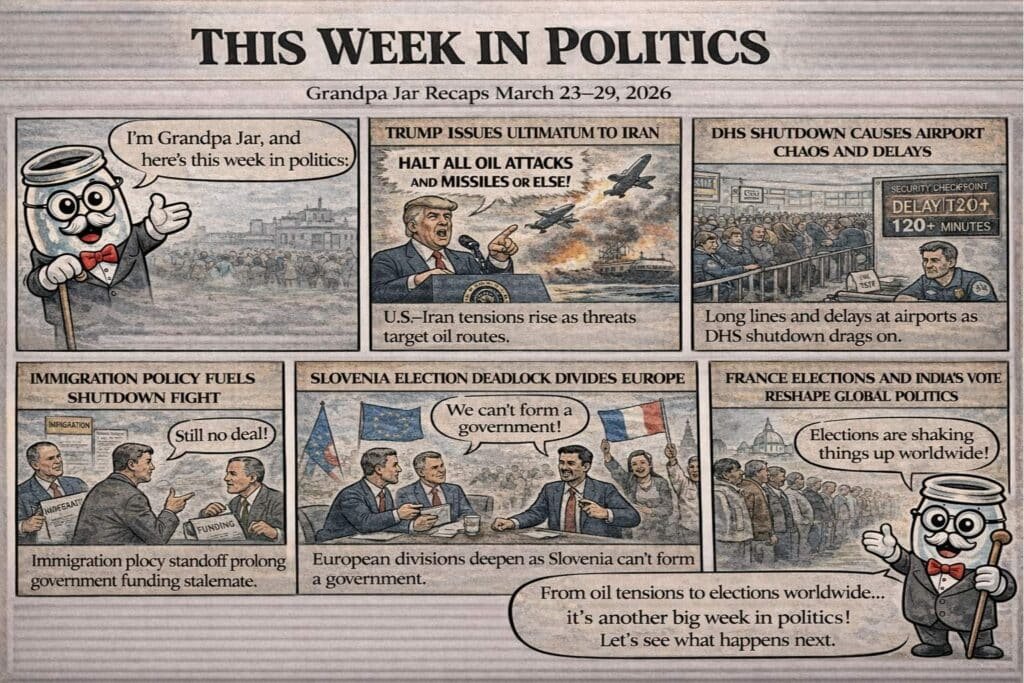
US President Donald Trump warned that the United States would “hit and obliterate” Iran’s power plants if Tehran did not fully reopen the Strait of Hormuz to shipping within 48 hours, issuing the ultimatum on his social media platform over the weekend. Iran has effectively restricted traffic through the strait during a three‑week‑old conflict, prompting threats to mine Gulf sea lanes and to target energy and water infrastructure across the region if its own facilities are attacked. On March 21, Iranian missile barrages struck the Israeli cities of Dimona and Arad, injuring close to 200 people and bringing the war directly to the vicinity of Israel’s main nuclear research center. After financial markets and oil prices reacted sharply, Trump announced on March 23 that he was pausing planned strikes on Iranian power plants for five days, saying “productive conversations” were under way about de‑escalation, even as US and Israeli forces continued other operations.
Why It Matters
The Strait of Hormuz carries roughly one‑fifth of the world’s oil supply, so any sustained closure or threat of mining raises the risk of higher energy prices, market volatility, and potential fuel shortages worldwide. The exchange of threats over civilian energy infrastructure, combined with missile attacks near Israel’s nuclear facilities, marks a dangerous shift toward targeting high‑value sites rather than purely military positions, increasing the chances of miscalculation or a wider regional war. For ordinary people, the fallout is likely to be felt through higher fuel and transport costs, renewed pressure on inflation, and political debates in many countries over defense spending and involvement in Middle East conflicts.
DHS Shutdown, TSA Chaos, and Trump’s Executive Order
The News
The partial shutdown of the US Department of Homeland Security (DHS), which began on February 14 amid a dispute over immigration enforcement, stretched into its sixth week, leaving over 100,000 DHS employees without full paychecks and severely straining airport security operations. About 50,000 Transportation Security Administration (TSA) officers worked without pay for weeks, leading to long security lines, rising absenteeism, and hundreds of resignations, with some major US airports reporting wait times of three to four hours or more. In the early hours of March 27, the US Senate approved a stopgap bill to fund most of DHS—including TSA and the Coast Guard—but excluded Immigration and Customs Enforcement (ICE) removal operations, a key sticking point in the standoff. House Republican leaders signaled opposition to the Senate’s ICE‑free approach, and as prospects for a quick deal dimmed, Trump signed an executive order directing DHS to pay TSA officers using existing funds even as the shutdown formally continued.
Why It Matters
The DHS shutdown has highlighted how partisan fights over immigration policy can spill over into basic government functions, from airport security to disaster relief, with economic losses estimated in the billions of dollars and widespread disruption for travelers. Trump’s decision to order payments to TSA workers while Congress remains deadlocked raises fresh questions about executive power over the budget process and could set a precedent for future presidents to bypass lawmakers in high‑profile funding disputes. For voters, the episode offers a preview of the 2026 midterm campaign arguments on governance and border policy: Republicans emphasizing strict enforcement and Democrats highlighting shutdown costs and worker hardship.
Slovenia’s Election Deadlock and EU Political Fault Lines
The News
Slovenia’s parliamentary election on March 22 produced a near‑perfect tie between Prime Minister Robert Golob’s liberal Freedom Movement and the right‑wing Slovenian Democratic Party (SDS) led by former Prime Minister Janez Janša. With about 99 percent of votes counted, the Freedom Movement won roughly 28.5 percent of the vote compared with about 28.1 percent for SDS, leaving neither close to a majority in the 90‑seat parliament and guaranteeing protracted coalition talks. The campaign was marked by corruption allegations and reports that Janša met with the Israeli intelligence firm Black Cube, prompting accusations of foreign interference from Golob and his allies.
Why It Matters
The result leaves Slovenia facing a period of political uncertainty, with smaller parties now in kingmaker roles and no clear path to a stable government. At the European level, the vote is seen as a test of whether a small EU member state will continue on a broadly liberal, pro‑Brussels course under Golob or tilt more toward the nationalist right, where Janša has positioned himself as an ally of leaders like Hungary’s Viktor Orbán. For EU citizens, Slovenia’s deadlock underscores how fragmented parliaments and tight races are becoming more common, complicating efforts to maintain unity on issues from migration to the war in the Middle East.
France’s Local Elections Reshape Urban Politics
The News
France held the second round of municipal elections on March 22, with results confirming that the centre‑left has held onto several of the country’s largest cities while the far right advanced in others. In Paris, Socialist candidate Emmanuel Grégoire was elected mayor with just over 53 percent of the vote, continuing a quarter‑century of left‑led rule in the capital; left‑wing incumbents also retained control of Marseille, Lyon, and other major urban centres. At the same time, the far‑right Rassemblement National (National Rally) and its allies claimed their biggest local breakthrough yet, notably winning the strategically important Mediterranean city of Nice and consolidating power in several mid‑sized towns, even as they fell short in targets like Marseille and Nîmes. President Emmanuel Macron’s centrist camp posted mixed results, suffering setbacks in many local races but capturing high‑profile Bordeaux while former prime minister Édouard Philippe comfortably secured reelection in Le Havre.
Why It Matters
These local outcomes offer an early snapshot of France’s political balance ahead of the 2027 presidential race, showing a resurgent Socialist Party in big cities, a far right that is expanding but still struggles in some major urban areas, and a centrist bloc searching for firm ground. For residents, municipal control affects day‑to‑day issues like housing, transport, policing, and environmental policy, making these results immediately tangible even as national leaders read them as indicators of broader momentum. The fragmented picture also mirrors trends across Europe, where traditional parties, green forces, and far‑right movements increasingly share the urban political space, complicating coalition‑building and policy coherence.
India’s April State Elections Announced Amid Energy Strains
The News
India’s Election Commission confirmed that four key states, including Tamil Nadu and West Bengal, will hold assembly elections in April, with voting scheduled for April 23 and April 29 in different phases. Prime Minister Narendra Modi’s Bharatiya Janata Party (BJP) will seek to expand or defend its foothold in these states while opposition parties aim to blunt the ruling party’s dominance and test new alliance strategies. The contests come as India grapples with rising inflation and power shortages linked in part to the Middle East conflict and volatility in global energy markets, placing the government’s economic management under intense scrutiny.
Why It Matters
Though formally state‑level, these elections will be read as a national referendum on Modi’s handling of the economy, energy security, and foreign policy at a time when the Iran conflict is driving up global fuel costs. Results in politically pivotal states like Tamil Nadu and West Bengal could reshape coalition arithmetic ahead of India’s next general election and influence how aggressively New Delhi pursues reforms or social‑welfare spending. For investors and regional neighbours, the votes offer clues about the stability of India’s policy direction at a moment when many countries are reassessing supply chains and energy ties in light of the Gulf crisis.
Final Summary
Across this weekly political news recap for March 23–29, 2026, a common thread is how war and economic pressure in the Middle East are reverberating through domestic politics from Washington to New Delhi. The US–Iran confrontation and the Strait of Hormuz blockade are driving up energy risks just as an extended DHS shutdown exposes the fragility of core government services and deep partisan divides in the United States. In Europe, France’s local elections and Slovenia’s hung parliament highlight a fractured landscape in which social democrats, centrists, greens, and nationalists all hold important pieces of power. Meanwhile, India’s looming state elections show how domestic political tests in major emerging economies are increasingly intertwined with global crises, from oil markets to regional security. Together, these stories suggest that voters everywhere are being asked to navigate a world where local issues, economic pain, and geopolitical shocks are more tightly linked than ever.
Follow Political Jar at Facebook, X (Twitter), YouTube, Bluesky and LinkedIn
The New Data Driven Political Tools at Political Jar: Election Results and Epstein Files Search