This Week in Politics: March 16–22, 2026 – Weekly Political News Recap
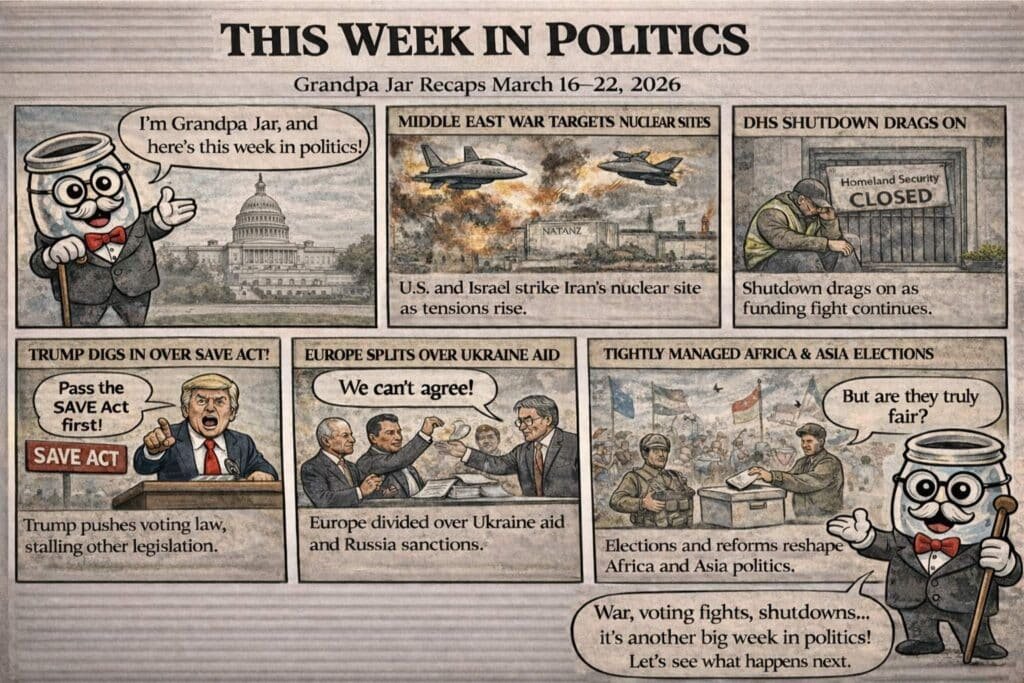
From escalating war in the Middle East to a bitter US voting-rights fight, EU splits over Ukraine, and tightly managed elections in Africa and Asia, this week’s global politics reshaped security, democracy, and energy markets.
Middle East War Escalates Around Nuclear Sites
The News
Iran’s atomic energy agency said the United States and Israel struck its key Natanz uranium enrichment facility on Saturday, March 21, reporting damage at the site but “no leakage of radioactive materials” and no off-site radiation spike, according to statements relayed by Tasnim and confirmed by the UN nuclear watchdog. The International Atomic Energy Agency (IAEA) said it had been notified of the attack and reported “no increase in off-site radiation levels,” while urging restraint to avoid a nuclear accident during the ongoing conflict.
In apparent retaliation, Iran launched missiles at towns near Israel’s Dimona nuclear complex, wounding at least 180 people in and around the southern cities of Dimona and Arad, though Israel reported no damage to its nuclear facilities. At the same time, US officials said Iran fired missiles toward the US base on Diego Garcia in the Indian Ocean, with one missile failing in flight and another intercepted, as President Donald Trump warned he could order strikes on Iranian power plants if Tehran does not fully reopen the Strait of Hormuz to global shipping.
Why It Matters
The exchange of strikes around Natanz and near Israel’s nuclear center dramatically raises the risk of a broader regional war that could involve radiological hazards even without a deliberate nuclear blast. While officials stress there has been no radiation release so far, any hit on nuclear infrastructure during active conflict heightens the chance of miscalculation or accidental contamination affecting civilians far beyond Iran and Israel.
Economically, Iran’s partial blockade of the Strait of Hormuz—through which a large share of global oil exports pass—combined with US threats to hit critical Iranian infrastructure, feeds volatility in energy prices and insurance costs for shipping. For ordinary people worldwide, that can mean higher fuel and transport prices and fresh pressure on already fragile supply chains, while also increasing the likelihood that governments divert resources toward defense rather than social spending.
US Voting Rights Showdown Over Trump’s SAVE America Act
The News
President Trump has vowed not to sign any legislation until Congress passes the Safeguard American Voter Eligibility (SAVE) America Act, dramatically escalating a showdown over federal voting rules ahead of the 2026 midterm elections. The House approved the bill in February after a pressure campaign from Trump, Elon Musk, and other conservative allies, but it currently lacks the 60 Senate votes needed to overcome a filibuster, leaving its fate uncertain.
The SAVE America Act would require documentary proof of US citizenship—such as a passport or birth certificate—for voter registration in federal elections and mandate photo ID for all ballots, including those cast by mail. It would also compel states to regularly purge noncitizens from voter rolls using a federal database, expand voter-roll audits, and sharply limit mail-in voting to a narrow set of exceptions such as military deployment, disability, or travel.
Why It Matters
Supporters argue the bill is needed to ensure that only citizens vote and to restore confidence in US elections after years of false claims about widespread fraud. They say nationwide ID and documentation rules would standardize procedures across states and prevent noncitizens from registering or casting ballots, even though prior federal investigations have found no evidence of large-scale noncitizen voting.
Critics—including voting-rights groups and many Democrats—warn the law could disenfranchise millions of eligible voters, especially women who changed their names, naturalized citizens, students, low-income Americans, and people without easy access to original documents. Because the requirements would take effect immediately, election officials say implementing the changes during an active election year could create chaos at registration offices and polling places, making it harder for legitimate voters to participate and increasing the risk of contested results.
DHS Shutdown Drags On Amid Immigration Policy Clash
The News
The US Department of Homeland Security (DHS) has remained partially shut down for more than five weeks after Senate Democrats again blocked a House-passed funding bill, with the latest cloture vote in the Senate failing 47–37 on Friday, March 20. This was at least the fifth unsuccessful attempt since mid-February to advance long-term DHS funding, as Democrats demand changes to immigration enforcement practices following a fatal January shooting of two US citizens by DHS agents in Minnesota.
Republicans, backed by the White House, have resisted Democratic proposals, instead trying to move a DHS bill that would fully fund immigration enforcement agencies while leaving current policies largely intact. The shutdown has hit the Transportation Security Administration particularly hard, with unpaid screeners increasingly calling in sick or quitting, leading to longer airport lines and warnings that some airports might temporarily shut checkpoints if funding is not restored soon.
Why It Matters
The standoff shows how immigration and border enforcement continue to dominate US domestic politics, now directly affecting the basic functioning of a critical security department. By tying DHS funding to policy concessions, both parties are using the shutdown as leverage, but the immediate costs fall on federal workers and travelers rather than elected officials.
For ordinary Americans, the shutdown is already translating into travel disruptions and uncertainty at airports, and a longer impasse could affect disaster response, cybersecurity coordination, and other DHS missions beyond border control. Politically, the episode reinforces partisan polarization around immigration, which could shape voter attitudes in November if the public blames one side for prolonged dysfunction and security lapses.
Europe Divided: Hungary’s Ukraine Veto and France’s Crackdown on Russia’s ‘Shadow Fleet’
The News
Hungarian Prime Minister Viktor Orbán blocked a proposed €90 billion European Union loan package for Ukraine at an EU summit in Brussels and threatened further “anti-Ukraine measures” to force the resumption of Russian oil deliveries through a pipeline crossing Ukrainian territory. Orbán said his government has “a lot of cards” and warned that Hungary could veto new EU sanctions on Russia, oppose including Ukraine aid in the next seven‑year EU budget, and even leverage the fact that roughly 40 percent of Ukraine’s electricity imports transit Hungary.
At the same time, France intensified enforcement of oil sanctions against Moscow when its navy intercepted and boarded the tanker Deyna in the western Mediterranean on Friday, March 20, suspecting it to be part of Russia’s “shadow fleet” used to evade price caps and export restrictions. French maritime authorities said the ship was flying the Mozambican flag but onboard documents cast doubt on its true registration, prompting France to escort it to anchorage near Marseille for further checks after coordination with allies including the United Kingdom.
Why It Matters
Orbán’s threats highlight how a single EU member state can obstruct collective decisions on Ukraine funding and Russia sanctions, exposing institutional vulnerabilities in the bloc’s unanimity rules for foreign and security policy. Hungary’s stance also underscores the enduring dependence of some Central European countries on Russian energy pipelines and how Moscow’s oil and gas remain powerful tools for influencing EU politics.
France’s interception of a suspected “shadow fleet” tanker shows that even as the EU struggles internally over long-term Ukraine aid, some member states are stepping up unilateral enforcement of sanctions against Russia’s oil exports. For consumers, tougher enforcement could tighten global oil supply and keep prices elevated, while for Ukraine, the combination of blocked EU aid and uneven sanctions pressure complicates its ability to sustain the war effort and rebuild its economy.
Elections and Constitutional Change in Africa and Asia
The News
In the Republic of the Congo, provisional results announced this week confirmed President Denis Sassou Nguesso’s re‑election to a fifth consecutive term with about 94.8 percent of the vote in the March 15 presidential election, extending his nearly 42 years in power. Observers and local media reported low enthusiasm and boycotts by major opposition parties, which accused the process of being unfair amid internet shutdowns, restrictions on movement, and arrests of activists before the vote.
Vietnam held its nationwide parliamentary election on March 15, with tens of millions of voters choosing 500 deputies to the National Assembly from a candidate list in which roughly 93 percent were fielded by the ruling Communist Party. Officials announced final results on March 21, reporting record turnout and confirming that 500 delegates had been elected, with the Communist Party retaining an overwhelming majority and a small number of independents winning seats.
Kazakhstan announced final results of its March 15 constitutional referendum, with about 87 percent of voters approving a new constitution and turnout reported above 70 percent, according to the Central Referendum Commission. The new charter rewrites much of the previous constitution and restructures institutions, including replacing the current parliament with a unicameral Kurultai and reintroducing a vice presidency, while also strengthening certain civil-rights language and codifying a definition of marriage as between a man and a woman.
Why It Matters
Sassou Nguesso’s lopsided win in Congo-Brazzaville illustrates how formal multiparty elections can coexist with entrenched personal rule, where opposition boycotts, media restrictions, and preemptive arrests limit genuine competition. For Congolese citizens, another term under a long‑standing leader may promise short‑term stability but offers little prospect of accountability or significant political reform, and signals to other African incumbents that dominant-party systems remain viable.
Vietnam’s election highlights the resilience of single‑party rule paired with high voter turnout, giving the Communist Party a renewed mandate to pursue rapid economic growth while keeping tight control over political dissent. Ordinary Vietnamese may benefit from continued stability and growth, but the narrow space for opposition and independent candidates limits avenues to challenge corruption, environmental policies, or local abuses through the ballot box.
In Kazakhstan, the new constitution is presented by President Kassym‑Jomart Tokayev as the foundation of a “New Kazakhstan,” but analysts note that some changes—such as the new institutional design and succession rules—could consolidate presidential influence even as other provisions strengthen formal checks and rights. Citizens will feel the effects as the new system rolls out, from how representatives are chosen to how rights like freedom of association and equality are interpreted, and the referendum’s overwhelming approval shows both support for change and the limits of organized opposition under semi‑authoritarian rule.
Final Summary Of Weekly Political News Recap
This week in politics was defined by an escalating US‑Israel–Iran conflict that brought strikes perilously close to nuclear facilities, a high‑stakes US battle over voting laws and a grinding DHS shutdown, and sharp European divisions over how to back Ukraine while policing Russia’s oil trade. At the same time, tightly managed elections and referendums in Congo-Brazzaville, Vietnam, and Kazakhstan underscored how leaders across Africa and Asia are using ballots and constitutional change to entrench power while projecting an image of popular legitimacy. Together, these developments highlight a world where security crises, energy politics, and democratic backsliding are increasingly interconnected, shaping everything from household budgets to citizens’ ability to hold their governments to account.
References
Al Jazeera. (2026, March 15). Vietnam holds general election, 93% candidates from ruling Communist Party. Al Jazeera. https://www.aljazeera.com/news/2026/3/15/vietnam-holds-general-election-93-candidates-from-ruling-communist-party
Al Jazeera. (2026, March 17). Congolese President Sassou Nguesso wins fifth term. Al Jazeera. https://www.aljazeera.com/news/2026/3/17/congos-president-nguesso-to-secure-fifth-term-provisional-results-predict
Al Jazeera. (2026, March 21). Iran says US and Israel attacked Natanz nuclear facility. Al Jazeera. https://www.aljazeera.com/news/2026/3/21/iran-says-us-and-israel-attacked-natanz-nuclear-facility
Al Jazeera. (2026, March 21). Iran strikes towns near Israel’s key nuclear site, at least 180 wounded. Al Jazeera. https://www.aljazeera.com/news/2026/3/21/iran-strikes-towns-near-israels-nuclear-site-in-escalating-tit-for-tat
Associated Press. (2026, March 20). Hungary’s Orbán threatens further anti-Ukraine measures over Russian oil dispute. AP News (via Halifax CityNews, Chron). https://halifax.citynews.ca / https://www.chron.com
British Broadcasting Corporation. (2026, March 20). Iranian missile strikes near Israeli nuclear facility, after Tehran says one of its sites targeted (Live page). BBC News. https://www.bbc.com/news/live/ce84073mr06t
CBS News. (2026, March 19). Senate fails to advance DHS funding bill for 5th time, with no deal in sight. CBS News. https://www.cbsnews.com/news/senate-vote-dhs-funding-shutdown-update
CNBC. (2026, March 21). Trump threatens attack on Iran power plants if Strait of Hormuz isn’t reopened. CNBC. https://www.cnbc.com/2026/03/21/iran-targeted-but-did-not-hit-diego-garcia-base-with-missiles-wsj.html
Council on Foreign Relations. (2025, December 8). Ten elections to watch in 2026. CFR. https://www.cfr.org/articles/ten-elections-watch-2026
Euronews. (2026, March 16). Kazakhstan: Largest country in Central Asia approves new constitution. Euronews. https://www.euronews.com/2026/03/17/largest-country-in-central-asia-votes-for-the-new-constitution
Euronews. (2026, March 19). France boards tanker suspected of being part of Russia’s shadow fleet. Euronews. https://www.euronews.com/2026/03/20/french-navy-boards-tanker-in-mediterranean-suspected-of-being-part-of-russias-shadow-fleet
Euronews. (2026, March 19). Hungary threatens further anti-Ukraine measures over oil dispute. Euronews. https://www.euronews.com/2026/03/20/hungary-threatens-further-anti-ukraine-measures-despite-european-leaders-rebuke
NBC News. (2026, March 11). What’s actually in Trump’s SAVE America voting bill. NBC News. https://www.nbcnews.com/politics/elections/trump-save-america-voting-bill-rcna262706
NPR. (2026, March 4). House rejects measure to constrain Trump’s authorities in Iran. NPR. https://www.npr.org/2026/03/04/nx-s1-5735867/war-powers-congress-iran
PBS NewsHour. (2026, March 11). How Trump’s SAVE Act would reshape voting and why critics are concerned. PBS. https://www.pbs.org/newshour/show/how-trumps-save-act-would-reshape-voting-and-why-critics-are-concerned
Qazinform News Agency. (2026, March 17). Final results of referendum on new Constitution of Kazakhstan announced. Qazinform. https://qazinform.com/news/final-results-of-referendum-on-new-constitution-of-kazakhstan-announced-74574d
Reuters. (2026, March 15). Vietnam votes as Communist Party fields nearly 93% of candidates in parliament elections. Reuters.
Reuters. (2026, March 18). Congo Republic’s Sassou wins re-election with nearly 95% of vote. Reuters (video).
Statista. (2026, February 25). Elections worldwide in 2026 – statistics & facts. Statista. https://www.statista.com/topics/50167/elections-worldwide-2026
The Investor / VNA. (2026, March 21). Results of Vietnam’s parliament election announced. The Investor. https://www.theinvestor.vn/results-of-vietnams-parliament-election-announced-d18661.html
The White House. (2026, March 9). The SAVE America Act. The White House. https://www.whitehouse.gov/saveamerica
United States Senate & Politico. (2026, March 20). Senate rejects DHS funding bill a fifth time – Live updates. Politico. https://www.politico.com/live-updates/2026/03/20/congress/senate-rejects-dhs-funding-bill-a-fifth-time-00838384
Follow Political Jar at Facebook, X (Twitter), YouTube, Bluesky and LinkedIn
The New Data Driven Political Tools at Political Jar: Election Results and Epstein Files Search