

This Week in Politics – February 16–22, 2026 – Political News Weekly Recap
The week of February 16 through February 22, 2026 unfolded against a backdrop of intensifying geopolitical competition, continued domestic policy debates in the United States, and democratic developments across multiple regions. As global leaders gathered for diplomatic coordination, economic pressures tested alliances, and domestic political conflicts continued to shape public discourse, the interconnected nature of modern politics was again on full display. This week’s Political News Recap highlights the most consequential developments and explains why each story carries significance beyond its immediate headlines.
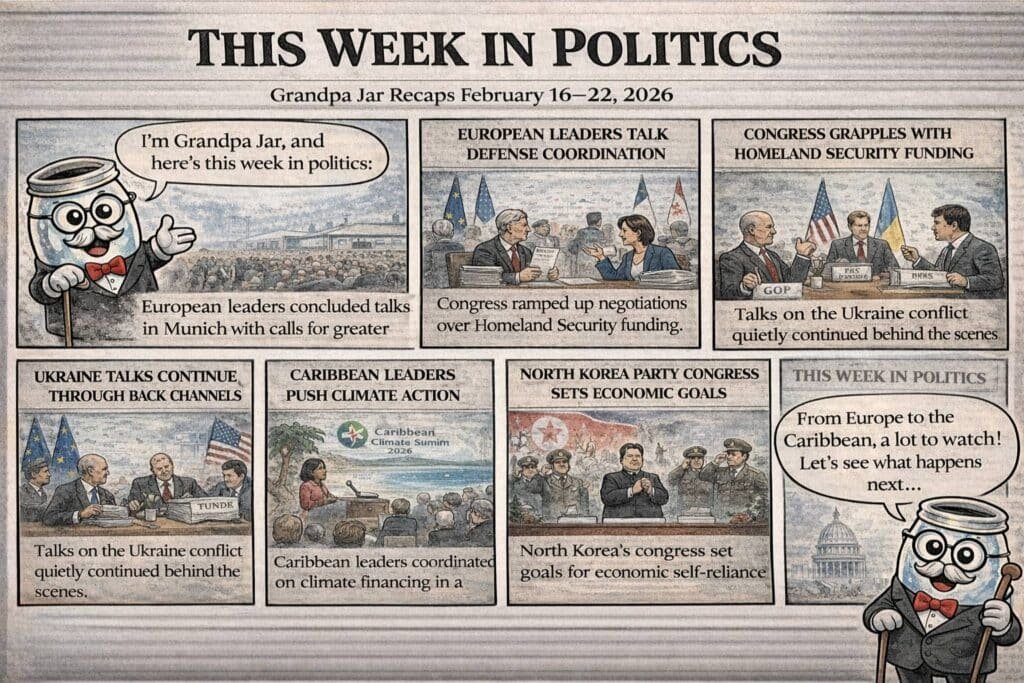
What Happened: Leaders Concluded the Munich Security Dialogue with Calls for Stronger European Defense
Following the conclusion of the Munich Security Conference earlier in February, European leaders continued discussions throughout the week regarding enhanced regional defense coordination. Several EU defense ministers met to explore mechanisms for expanded joint procurement, shared intelligence infrastructure, and collective rapid-response capabilities. The conversations reflected concerns that European security architecture must evolve amid ongoing instability stemming from the war in Ukraine and broader geopolitical competition.
U.S. officials reiterated their commitment to NATO but also encouraged European nations to assume greater responsibility for regional security investments. Public statements from European policymakers emphasized a complementary rather than replacement approach, framing defense autonomy as strengthening rather than undermining the transatlantic alliance.
Why It Matters
These discussions represent a subtle but meaningful shift in global security thinking. For decades, European defense planning relied heavily on U.S. leadership and military capacity. The emerging push for greater European capability signals a recalibration of alliance dynamics rather than a rupture. Increased European defense integration could lead to faster regional responses to crises, expanded industrial collaboration, and more balanced burden-sharing within NATO.
For the United States, this development may influence strategic planning, defense spending priorities, and diplomatic engagement with allies. For global observers, the discussions underscore a broader trend toward multipolar security frameworks where alliances remain intact but responsibilities are more distributed.
What Happened: Congressional Negotiations Intensified Over Homeland Security Funding
In Washington, lawmakers escalated negotiations over federal funding legislation affecting the Department of Homeland Security. The debate centered on immigration enforcement authorities, border security funding levels, and oversight mechanisms tied to federal enforcement operations. Congressional committees held hearings examining enforcement practices, civil liberties concerns, and resource allocation priorities.
While negotiations did not reach resolution by week’s end, bipartisan working groups reported incremental progress toward a potential compromise framework. Congressional leaders signaled that avoiding a funding disruption remained a priority, even as partisan disagreements over enforcement policy persisted.
Why It Matters
Budget negotiations serve as the operational backbone of government policy implementation. Disputes over Homeland Security funding are particularly consequential because they intersect with national security, immigration policy, law enforcement operations, and humanitarian considerations. Legislative compromises reached in this context often shape enforcement practices for years beyond a single fiscal cycle.
Politically, the negotiations reflect broader tensions within both parties as lawmakers balance constituent expectations, policy priorities, and institutional responsibilities. The outcome of these discussions will likely influence public perceptions of governance effectiveness and could become a defining issue in upcoming campaign cycles.
What Happened: Ukraine Conflict Diplomacy Continued Through Back-Channel Engagement
Diplomatic engagement related to the war in Ukraine persisted this week through informal and back-channel discussions among representatives from the United States, European Union, Ukraine, and intermediary states. While no formal peace initiative emerged, diplomatic officials described the conversations as constructive exchanges exploring humanitarian corridors, prisoner exchanges, and potential frameworks for future negotiations.
Reports indicated that both Ukrainian and Russian representatives expressed conditional openness to continued dialogue, particularly regarding localized ceasefire arrangements and civilian protection measures. Observers emphasized that such incremental diplomacy often precedes broader negotiations even when progress appears limited.
Why It Matters
The Ukraine conflict remains one of the defining geopolitical challenges of the decade. Sustained diplomatic engagement—even absent immediate breakthroughs—signals that avenues for negotiation remain viable. Incremental measures such as humanitarian agreements can reduce suffering while building confidence necessary for broader political settlement discussions.
For global stability, the continuation of dialogue helps mitigate risks of escalation and preserves diplomatic channels essential for crisis management. For domestic audiences in involved countries, visible diplomatic activity also shapes perceptions of leadership commitment to conflict resolution.
What Happened: Caribbean Leaders Advanced Climate Financing Agenda
Caribbean heads of government convened a regional summit during the week to advance proposals addressing climate adaptation financing, disaster resilience investment, and debt restructuring frameworks for small island developing states. The discussions built upon momentum generated by Barbados Prime Minister Mia Mottley’s reelection and her ongoing advocacy for global financial reform to better support climate-vulnerable nations.
Participants endorsed a joint declaration calling for expanded multilateral development bank lending flexibility, innovative financing mechanisms, and enhanced technical cooperation on climate resilience projects. International partners were invited to engage in follow-up consultations later in the year.
Why It Matters
Climate policy increasingly occupies the intersection of environmental, economic, and political governance. For small island nations, climate change represents not merely an environmental concern but a fundamental issue of national survival and economic stability. Regional coordination amplifies these nations’ voices within global institutions where financial decision-making often occurs.
The summit also reflects growing momentum toward reforming global financial architecture to address climate vulnerabilities more equitably. Such reforms could influence international lending practices, development priorities, and geopolitical relationships between advanced economies and developing states.
What Happened: North Korea Party Congress Concluded with Emphasis on Economic Self-Reliance
North Korea concluded its Workers’ Party congress during the week, announcing policy priorities focused on domestic industrial expansion, agricultural modernization, and continued military readiness. Official communications highlighted economic self-reliance initiatives while reaffirming commitments to national defense modernization.
International analysts interpreted the announcements as signaling continuity rather than dramatic policy shifts. Observers noted that the congress reinforced existing strategic messaging emphasizing sovereignty, deterrence, and controlled engagement with external partners.
Why It Matters
Policy signals emerging from North Korean leadership forums are closely monitored due to their implications for regional security and diplomatic engagement prospects. Emphasis on economic development alongside military readiness suggests a dual-track strategy balancing domestic legitimacy and strategic deterrence.
For neighboring countries and international stakeholders, the congress outcomes provide insight into potential future policy directions affecting diplomatic negotiations, sanctions policy considerations, and regional stability calculations.
What Happened: U.S. State Elections Continued to Offer Signals Ahead of Midterms
Several local and state-level elections held during the week generated attention as analysts examined turnout patterns, issue salience, and demographic voting trends. While none of the contests individually carried national policy consequences, collectively they offered data points shaping early assessments of political momentum heading into the 2026 midterm cycle.
Campaign messaging across these races frequently centered on economic affordability, public safety, education policy, and immigration issues. Analysts noted that voter priorities appeared increasingly localized even when national political narratives remained prominent.
Why It Matters
State and local elections function as early indicators of broader political dynamics. Shifts in turnout, issue emphasis, and candidate performance can inform national party strategies, fundraising priorities, and policy framing. These contests also highlight how voters often evaluate political leadership through the lens of local governance experiences.
Understanding these patterns is essential for interpreting evolving political landscapes and anticipating potential electoral developments at higher levels of government.
What to Watch For
- Continued European defense coordination initiatives and their implications for NATO burden-sharing
- Congressional progress toward Homeland Security funding agreements and oversight provisions
- Diplomatic follow-up discussions related to Ukraine humanitarian arrangements
- Caribbean climate financing negotiations with international financial institutions
- Regional reactions to North Korea’s policy announcements and potential diplomatic engagement signals
- Emerging voter behavior trends as state election data accumulates ahead of midterm campaigns
References
Associated Press. (2026, February 18). European defense ministers discuss expanded cooperation following Munich conference.
Reuters. (2026, February 20). U.S. lawmakers intensify negotiations over Homeland Security funding package.
Reuters. (2026, February 19). Back-channel diplomacy continues among Ukraine conflict stakeholders.
Associated Press. (2026, February 21). Caribbean leaders push for global climate financing reforms at regional summit.
Associated Press. (2026, February 22). North Korea concludes party congress emphasizing economic self-reliance.
Pew Research Center. (2026, February 17). State election turnout trends offer early insights into midterm dynamics.
Follow Political Jar on our X (Twitter) , Facebook and YouTube Pages
IFor more curated political news visit the Political Jar Political News page
