
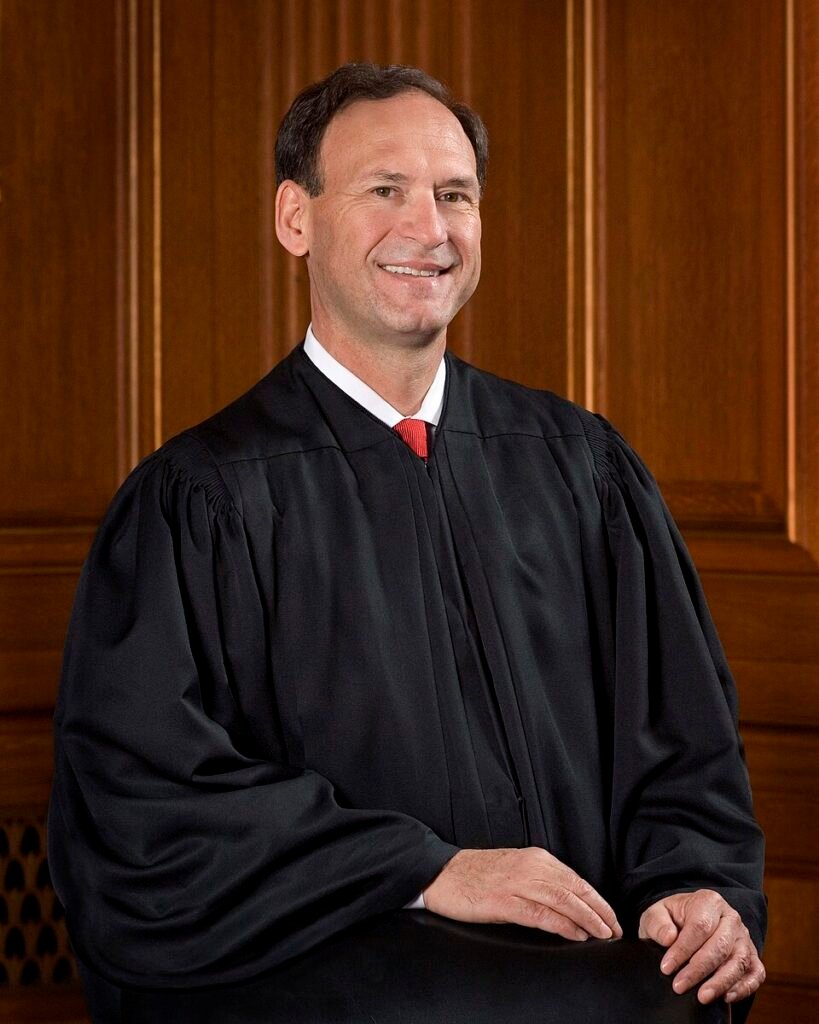
Samuel Alito
Judicial Details
Education
Personal Details
Contact Information
Status
Basic Information
Supreme Court Justice Samuel A. Alito Jr.
When Samuel A. Alito Jr. joined the Supreme Court of the United States in January 2006, he did so as a jurist already shaped by decades in federal service. Supreme Court Justice Samuel A. Alito Jr. arrived with a prosecutor’s discipline, an appellate judge’s caution, and a constitutional philosophy grounded in textualism and historical analysis. Over the course of nearly two decades on the Court, Justice Samuel Alito has become one of its most consistently conservative voices, authoring opinions that have reshaped abortion law, religious liberty doctrine, campaign finance, and the balance between individual rights and governmental authority.
To understand Supreme Court Justice Samuel A. Alito Jr. is to trace the path of a lawyer steeped in federal institutions and deeply influenced by debates over constitutional interpretation that defined the late 20th century.
Early Life and Education
Samuel Anthony Alito Jr. was born on April 1, 1950, in Trenton, New Jersey, to Italian-American parents. His father, Samuel A. Alito Sr., was an educator and later director of the New Jersey Office of Legislative Services. His mother, Rose Fradusco Alito, was a schoolteacher. Public service and education were central to the Alito household, shaping a worldview attentive to both government structure and civic responsibility.
Alito attended Princeton University, graduating in 1972 with a degree in politics. His senior thesis examined the Warren Court and the expansion of constitutional rights, reflecting early interest in constitutional adjudication. He then enrolled at Yale Law School, where he earned his Juris Doctor in 1975.
While at Yale, Samuel A. Alito Jr. encountered the intellectual currents that would define his judicial career: debates over originalism, judicial restraint, and the proper limits of federal power. Though less publicly outspoken during law school than some contemporaries, Alito’s academic record and analytical rigor were widely noted.
Early Career and Federal Service
After law school, Alito clerked for Judge Leonard I. Garth of the U.S. Court of Appeals for the Third Circuit. The clerkship provided early exposure to federal appellate work and introduced him to the interpretive habits that would later characterize his judicial writing.
He began his legal career as an Assistant U.S. Attorney in the District of New Jersey in 1977. As a federal prosecutor, Samuel A. Alito Jr. handled a range of criminal cases and developed a reputation for careful preparation and steady courtroom demeanor.
In the 1980s, he joined the U.S. Department of Justice, serving in the Office of the Solicitor General and later as Deputy Assistant Attorney General in the Office of Legal Counsel. These roles placed him at the center of constitutional litigation and executive-branch advisory work. He worked on cases involving separation of powers, federalism, and administrative law—subjects that would become recurring themes in his later judicial opinions.
From 1987 to 1990, Alito served as U.S. Attorney for the District of New Jersey. His tenure there emphasized enforcement of federal criminal laws and administrative oversight.
The Third Circuit Years
In 1990, President George H. W. Bush nominated Samuel A. Alito Jr. to the U.S. Court of Appeals for the Third Circuit. Confirmed by the Senate, Alito began what would become a 15-year tenure on the appellate bench.
On the Third Circuit, Alito earned the nickname “Scalito” among some commentators, referencing his perceived alignment with Justice Antonin Scalia’s textualist approach. While the label was simplistic, it reflected Alito’s careful attention to statutory language and constitutional text.
One of his most discussed appellate opinions came in Planned Parenthood v. Casey (1991), where he dissented in part from the majority decision invalidating a spousal notification requirement in Pennsylvania’s abortion law. Though the Supreme Court later modified aspects of that ruling, Alito’s dissent signaled his skepticism toward expansive interpretations of abortion rights under Roe v. Wade.
Throughout his Third Circuit service, Samuel A. Alito Jr. authored opinions addressing search and seizure law, employment discrimination, federal jurisdiction, and administrative procedure. His writing style was measured, often technical, and rooted in precedent.
Nomination to the Supreme Court
In 2005, following the retirement of Justice Sandra Day O’Connor, President George W. Bush nominated Samuel A. Alito Jr. to the Supreme Court. The nomination followed the withdrawal of Harriet Miers and was widely viewed as an effort to solidify conservative support.
Alito’s confirmation hearings focused heavily on abortion, executive power, and civil liberties. After extended debate, the Senate confirmed him in January 2006 by a vote of 58–42.
With his confirmation, Supreme Court Justice Samuel A. Alito Jr. became the 110th Justice of the United States.
Jurisprudence on the Supreme Court
Over the years, Justice Samuel Alito has emerged as a leading voice on issues involving religious liberty, free speech, abortion, and administrative authority.
Among the most significant cases involving Supreme Court Justice Samuel A. Alito Jr.:
-
Citizens United v. Federal Election Commission (2010)
Alito joined the majority expanding First Amendment protections for corporate political expenditures. The decision dramatically reshaped campaign finance law. -
Burwell v. Hobby Lobby Stores, Inc. (2014)
Alito authored the majority opinion holding that closely held corporations could claim religious exemptions under the Religious Freedom Restoration Act from certain contraceptive mandates. The ruling marked a significant expansion of religious liberty protections in the corporate context. -
Obergefell v. Hodges (2015)
Alito dissented from the Court’s recognition of same-sex marriage as a constitutional right, warning that the decision could conflict with religious liberty claims. -
Janus v. American Federation of State, County, and Municipal Employees (2018)
He authored the majority opinion striking down mandatory union agency fees for public-sector employees, overturning longstanding precedent. -
Dobbs v. Jackson Women’s Health Organization (2022)
Justice Samuel A. Alito Jr. authored the majority opinion overturning Roe v. Wade and Planned Parenthood v. Casey. The decision returned authority over abortion regulation to the states and marked one of the most consequential constitutional shifts in decades. -
Masterpiece Cakeshop v. Colorado Civil Rights Commission (2018)
Alito joined the majority siding with a baker who refused to create a wedding cake for a same-sex couple, citing religious objections.
Across these decisions, Supreme Court Justice Samuel A. Alito Jr. has consistently emphasized historical understanding of constitutional rights and skepticism toward judicially created doctrines not firmly rooted in text or tradition.
Judicial Philosophy
Justice Samuel Alito is widely regarded as a textualist and originalist. His opinions often rely on historical analysis and the original public meaning of constitutional provisions. He has been critical of what he views as judicial overreach and has advocated for deference to legislative authority where constitutional text permits.
Unlike some colleagues who seek narrower rulings, Alito has at times been willing to reconsider precedent directly, as demonstrated in Dobbs. His writing style is detailed and doctrinally dense, frequently addressing counterarguments with systematic precision.
Public Presence and Controversies
In recent years, Justice Samuel Alito has drawn public attention for speeches and commentary outside the courtroom, as well as for scrutiny regarding ethics standards and public perception of judicial impartiality. As debates about Supreme Court ethics and transparency have intensified, Alito has defended the integrity of his judicial conduct.
Despite public controversy, Supreme Court Justice Samuel A. Alito Jr. has continued to articulate a jurisprudence rooted in constitutional text and history.
Personal Life
Samuel A. Alito Jr. married Martha-Ann Bomgardner in 1985. The couple has two children and resides in Virginia. Alito maintains a relatively private personal life, rarely engaging publicly beyond judicial duties and occasional academic speeches.
Legacy
The legacy of Supreme Court Justice Samuel A. Alito Jr. is already substantial. His authorship of Dobbs alone ensures his place in constitutional history. His influence extends across religious liberty doctrine, free speech law, union regulation, and the broader recalibration of federal power.
As the Supreme Court continues to confront polarizing national issues, Justice Samuel Alito remains one of its most doctrinally consistent members. Whether praised as a defender of constitutional originalism or criticized for reshaping long-settled precedent, his imprint on American law is undeniable.
References (APA Style)
Burwell v. Hobby Lobby Stores, Inc., 573 U.S. 682 (2014).
Citizens United v. Federal Election Commission, 558 U.S. 310 (2010).
Dobbs v. Jackson Women’s Health Organization, 597 U.S. ___ (2022).
Janus v. American Federation of State, County, and Municipal Employees, 585 U.S. ___ (2018).
Masterpiece Cakeshop v. Colorado Civil Rights Commission, 584 U.S. ___ (2018).
Obergefell v. Hodges, 576 U.S. 644 (2015).
Supreme Court of the United States. (n.d.). Biographies of the Justices: Samuel A. Alito Jr.
Greenhouse, L. (2012). The U.S. Supreme Court: A very short introduction. Oxford University Press.
Toobin, J. (2007). The nine: Inside the secret world of the Supreme Court. Doubleday.