
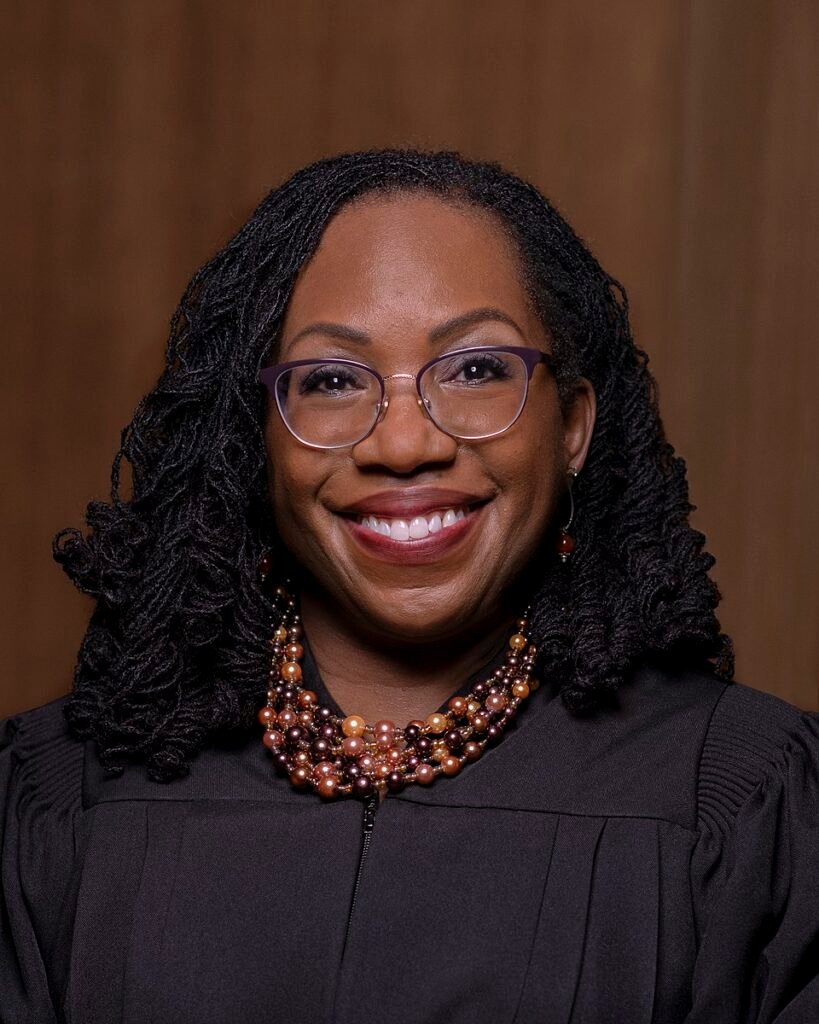
Ketanji Brown Jackson
Judicial Details
Education
Personal Details
Contact Information
Additional Resources
Status
Basic Information
Supreme Court Justice Ketanji Brown Jackson
When Ketanji Brown Jackson raised her right hand in June 2022 and took the constitutional oath, she became the first Black woman in the history of the United States to serve on the Supreme Court. The moment was historic, but it was also the culmination of a career that had unfolded deliberately across every major tier of the federal judiciary. Supreme Court Justice Ketanji Brown Jackson arrived on the Court with experience as a public defender, trial judge, appellate judge, and member of the U.S. Sentencing Commission—an unusually broad résumé in modern Supreme Court history.
To understand Supreme Court Justice Ketanji Brown Jackson is to understand a jurist shaped by the practical realities of criminal law, the discipline of trial courts, and the institutional demands of appellate review.
Early Life and Education
Ketanji Onyika Brown Jackson was born on September 14, 1970, in Washington, D.C., and raised in Miami, Florida. Her parents, Johnny Brown and Ellery Brown, were both public school educators. Her father later attended law school, an experience that deeply influenced Jackson. As she has often recalled, she would sit at the kitchen table doing homework alongside her father as he studied for his law exams.
Jackson attended Miami Palmetto Senior High School, where she excelled academically and participated in speech and debate competitions. She was elected student body president and developed early skills in public speaking and structured argument—tools that would later define her courtroom presence.
She enrolled at Harvard University, graduating magna cum laude in 1992 with a degree in government. At Harvard, Jackson performed in theater productions and engaged in public service activities, reflecting both intellectual rigor and creative range.
She then attended Harvard Law School, earning her Juris Doctor in 1996. During law school, she served as supervising editor of the Harvard Law Review, placing her within the academic and professional networks that shape elite legal careers.
Clerkships and Early Legal Career
After law school, Ketanji Brown Jackson clerked for Judge Patti B. Saris of the U.S. District Court for the District of Massachusetts and for Judge Bruce M. Selya of the U.S. Court of Appeals for the First Circuit. She later clerked for Justice Stephen G. Breyer of the Supreme Court during the 1999–2000 term—a connection that would later take on historic significance when she succeeded him on the Court.
Jackson entered private practice before joining the U.S. Sentencing Commission as an assistant special counsel in 2003. Her work there focused on federal sentencing policy and guideline reform. She later returned to the Commission as Vice Chair from 2010 to 2014, participating in efforts to reduce disparities in sentencing for drug offenses.
Perhaps most distinctive in her background was her service as a federal public defender. From 2005 to 2007, Jackson worked as an assistant federal public defender in Washington, D.C., representing indigent defendants in federal court. Few Supreme Court justices have had direct experience representing criminal defendants, and that perspective would later inform her judicial opinions.
U.S. District Court Service
In 2012, President Barack Obama nominated Ketanji Brown Jackson to serve on the U.S. District Court for the District of Columbia. The Senate confirmed her, and she began presiding over trial-level proceedings in one of the nation’s most high-profile federal courts.
As a district judge, Jackson handled cases involving administrative law, constitutional challenges, and federal criminal prosecutions. Her rulings demonstrated meticulous attention to procedural detail and factual record-building.
Among her notable decisions was a 2019 ruling requiring former White House Counsel Don McGahn to comply with a congressional subpoena, emphasizing that “presidents are not kings.” Though later narrowed on appeal, the decision underscored her view of the judiciary’s role in maintaining constitutional balance.
Her trial court experience gave Justice Ketanji Brown Jackson an uncommon perspective among Supreme Court justices: familiarity with evidentiary disputes, jury instructions, and the day-to-day realities of federal litigation.
D.C. Circuit Appointment
In 2021, President Joseph R. Biden Jr. nominated Jackson to the U.S. Court of Appeals for the District of Columbia Circuit, widely considered the second most powerful court in the nation. She was confirmed with bipartisan support.
On the D.C. Circuit, Jackson participated in cases involving administrative agency authority, labor law, and criminal appeals. Though her tenure there was brief before elevation to the Supreme Court, it reinforced her credentials as an appellate jurist.
Nomination to the Supreme Court
In February 2022, President Biden nominated Ketanji Brown Jackson to replace retiring Justice Stephen G. Breyer. The nomination fulfilled Biden’s campaign pledge to appoint the first Black woman to the Court.
During confirmation hearings, Jackson faced extensive questioning regarding her sentencing decisions in child pornography cases, her representation of detainees at Guantánamo Bay, and her judicial philosophy. She emphasized her commitment to impartiality and adherence to precedent.
The Senate confirmed Supreme Court Justice Ketanji Brown Jackson by a vote of 53–47 in April 2022.
Jurisprudence on the Supreme Court
As one of the Court’s newest members, Justice Ketanji Brown Jackson’s body of Supreme Court opinions is still developing. Nevertheless, she has already made her presence known through detailed dissents and concurrences.
Among the significant cases involving Supreme Court Justice Ketanji Brown Jackson:
-
Students for Fair Admissions v. Harvard (2023)
Justice Jackson authored a dissent criticizing the majority’s decision to strike down race-conscious admissions policies, arguing that the ruling ignored historical inequalities and constrained universities’ ability to promote diversity. -
Biden v. Nebraska (2023)
She dissented from the majority opinion invalidating the Biden administration’s student loan forgiveness plan, arguing that the Court had exceeded its institutional role. -
Moore v. Harper (2023)
Justice Ketanji Brown Jackson joined the majority rejecting a broad interpretation of the independent state legislature theory, reinforcing limits on state legislative authority in federal elections. -
United States v. Rahimi (2024)
Jackson participated in the Court’s Second Amendment jurisprudence as it clarified standards for firearm restrictions involving domestic violence restraining orders.
In her opinions, Justice Jackson often emphasizes statutory text while also engaging historical context and real-world implications. Her writing frequently reflects concern for access to justice and institutional accountability.
Judicial Philosophy
Supreme Court Justice Ketanji Brown Jackson has described her approach as rooted in textual analysis, respect for precedent, and awareness of practical consequences. Her background as a public defender gives her a distinct perspective on criminal procedure and sentencing.
She has emphasized the judiciary’s role in checking governmental overreach while respecting separation of powers. In dissents, she has articulated concerns about the Court narrowing avenues for relief or expanding judicial power beyond constitutional limits.
Writing Style and Public Presence
Justice Jackson’s writing style is deliberate and detailed, often weaving historical context with doctrinal reasoning. She has quickly established herself as a clear and forceful dissenter.
Outside the courtroom, she has engaged in educational outreach, emphasizing civic literacy and the importance of representation. Her appointment carries symbolic weight, but she has consistently framed her role as grounded in law rather than symbolism.
Personal Life
Ketanji Brown Jackson married Dr. Patrick Jackson, a surgeon, in 1996. The couple has two daughters. She is related by marriage to former House Speaker Paul Ryan, reflecting the complex intersections of American public life.
Colleagues describe her as warm, disciplined, and meticulous in preparation.
Legacy
The legacy of Supreme Court Justice Ketanji Brown Jackson is still unfolding. As the Court navigates contentious questions involving race, executive authority, and administrative power, her voice has already emerged as a significant one within the Court’s liberal wing.
Her journey—from Miami classrooms to Harvard, from public defender to Supreme Court justice—embodies both individual achievement and institutional transformation.
In a Court often scrutinized for its distance from everyday Americans, Justice Ketanji Brown Jackson brings firsthand knowledge of the criminal justice system’s human impact. That perspective will shape constitutional dialogue for decades to come.
References (APA Style)
Biden v. Nebraska, 600 U.S. ___ (2023).
Moore v. Harper, 600 U.S. ___ (2023).
Students for Fair Admissions v. Harvard, 600 U.S. ___ (2023).
United States v. Rahimi, 602 U.S. ___ (2024).
Supreme Court of the United States. (n.d.). Biographies of the Justices: Ketanji Brown Jackson.
U.S. Senate Committee on the Judiciary. (2022). Nomination hearing materials for Judge Ketanji Brown Jackson.