
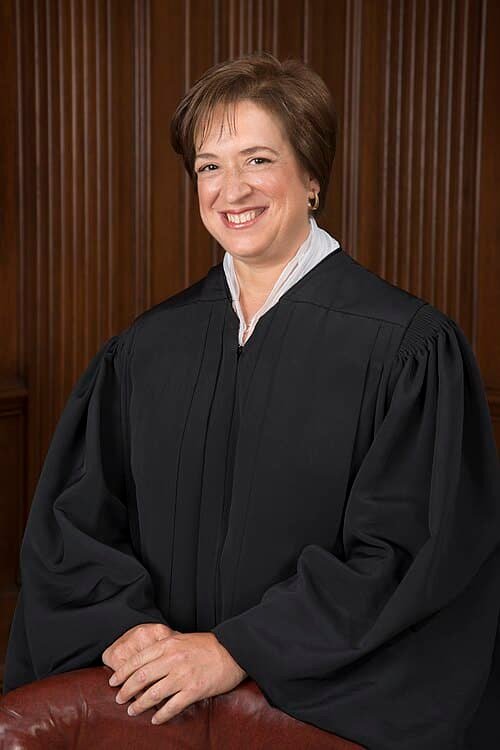
Elena Kagan
Judicial Details
Education
Personal Details
Contact Information
Additional Resources
Status
Basic Information
Supreme Court Justice Elena Kagan
When Elena Kagan joined the Supreme Court of the United States in August 2010, she did so without prior judicial experience—an increasingly rare path in the modern era. Yet Supreme Court Justice Elena Kagan arrived with a résumé that reflected immersion at the highest levels of American legal life: scholar, law school dean, White House policy adviser, and Solicitor General of the United States. Over more than a decade on the bench, Justice Elena Kagan has emerged as one of the Court’s most agile writers and incisive questioners, known for clarity, intellectual breadth, and a pragmatic understanding of how law functions in real institutions.
To understand Supreme Court Justice Elena Kagan is to trace the development of a jurist shaped by academia, public service, and a deep engagement with constitutional structure and administrative governance.
Early Life and Education
Elena Kagan was born on April 28, 1960, in New York City and raised on Manhattan’s Upper West Side. Her father, Robert Kagan, was an attorney specializing in tenant representation, and her mother, Gloria Kagan, was a public school teacher. Law and civic responsibility were part of her early environment.
Kagan attended Hunter College High School, a selective public school in Manhattan, where she excelled academically and demonstrated early interest in public life. She later enrolled at Princeton University, graduating summa cum laude in 1981 with a degree in history. Her senior thesis examined the political thought of American progressivism and socialism in the early 20th century, reflecting her longstanding interest in governance and institutional reform.
Following Princeton, Elena Kagan attended Worcester College at Oxford University, earning a Master of Philosophy degree. She then entered Harvard Law School, graduating magna cum laude in 1986. At Harvard, she served as supervising editor of the Harvard Law Review, positioning herself within the intellectual center of American legal discourse.
Clerkships and Academic Career
After law school, Elena Kagan clerked for Judge Abner Mikva of the U.S. Court of Appeals for the District of Columbia Circuit and later for Justice Thurgood Marshall of the Supreme Court during the 1987–88 term. Her clerkship with Justice Marshall left a lasting imprint. Marshall’s approach to constitutional law—deeply aware of the real-world implications of doctrine—helped shape Kagan’s appreciation for both legal reasoning and social context.
Following her clerkships, Kagan entered academia. She joined the faculty at the University of Chicago Law School in the early 1990s, where she taught constitutional law and administrative law. During her time there, she gained a reputation as a rigorous scholar capable of engaging colleagues across ideological divides.
Her academic writing often focused on presidential administration and the evolving role of the executive branch in shaping regulatory policy. Her scholarship examined how presidents influence administrative agencies, offering nuanced analysis rather than categorical criticism or endorsement.
Service in the Clinton Administration
Elena Kagan’s career in public service expanded during the Clinton administration. She served first as Associate Counsel to the President and later as Deputy Assistant to the President for Domestic Policy. In these roles, she worked on issues ranging from gun control to regulatory policy, gaining firsthand experience in executive decision-making.
Her time in the White House deepened her understanding of the interplay between politics and constitutional structure—an understanding that would later inform her judicial opinions in separation-of-powers cases.
Dean of Harvard Law School
In 2003, Elena Kagan returned to Harvard Law School as dean. As the first woman to serve in that role, she emphasized intellectual diversity and faculty expansion. Kagan worked to recruit scholars from across the ideological spectrum, strengthening Harvard’s academic breadth.
Her tenure as dean was widely regarded as successful. She was known for administrative skill, collegiality, and strategic vision. Though she had not yet served as a judge, her leadership at Harvard elevated her national profile.
Solicitor General of the United States
In 2009, President Barack Obama nominated Elena Kagan to serve as Solicitor General. Confirmed by the Senate, she became the first woman to hold that position.
As Solicitor General, Kagan argued six cases before the Supreme Court. The role required not only advocacy skill but also careful navigation of the federal government’s legal positions. Her arguments were noted for clarity and composure, and she quickly became familiar to the justices she would soon join.
Nomination to the Supreme Court
In 2010, following the retirement of Justice John Paul Stevens, President Obama nominated Elena Kagan to the Supreme Court. Her nomination drew attention in part because she had never served as a judge—a rarity in modern appointments.
During her confirmation hearings, she was questioned about executive power, Second Amendment rights, and military recruiting policies at Harvard. Kagan emphasized adherence to precedent and the limited role of personal policy preferences in judicial decision-making.
The Senate confirmed Supreme Court Justice Elena Kagan by a vote of 63–37.
Jurisprudence on the Supreme Court
Since joining the Court, Justice Elena Kagan has become known for her precise writing and strategic dissents. While generally aligned with the Court’s liberal wing, she has occasionally joined cross-ideological majorities in statutory interpretation cases.
Among the most significant cases involving Supreme Court Justice Elena Kagan:
-
Arizona Christian School Tuition Organization v. Winn (2011)
Kagan wrote a forceful dissent criticizing the majority’s standing analysis in an Establishment Clause case. -
King v. Burwell (2015)
She joined the majority upholding the Affordable Care Act’s tax credit provisions, emphasizing statutory interpretation grounded in context and purpose. -
Kimble v. Marvel Entertainment, LLC (2015)
Kagan authored the majority opinion upholding a precedent concerning patent royalties, famously referencing Spider-Man to illustrate the doctrine of stare decisis. -
Rucho v. Common Cause (2019)
In dissent, Kagan criticized the majority’s decision that partisan gerrymandering claims present nonjusticiable political questions. -
Bostock v. Clayton County (2020)
She joined the majority holding that Title VII prohibits discrimination based on sexual orientation and gender identity. -
West Virginia v. Environmental Protection Agency (2022)
Kagan authored a dissent arguing that the Court had overstepped in limiting the EPA’s authority under the Clean Air Act.
Across these decisions, Supreme Court Justice Elena Kagan has emphasized statutory context, precedent, and institutional competence. Her dissents often seek to frame legal debates in terms that may resonate with future courts.
Judicial Philosophy and Style
Justice Elena Kagan is frequently described as a pragmatic textualist. She respects statutory language but also emphasizes context and legislative purpose. Her opinions often display structural reasoning and careful engagement with opposing arguments.
Unlike some colleagues who rely heavily on historical analysis, Kagan often centers contemporary statutory meaning and functional governance concerns. She has been particularly attentive to the role of administrative agencies and the complexities of modern regulatory systems.
Her writing style is widely admired for clarity, wit, and accessibility—qualities that have made her opinions frequently cited in legal scholarship.
Public Persona and Personal Life
Elena Kagan is known for a reserved public demeanor combined with a dry sense of humor. She is unmarried and has no children. Colleagues describe her as collegial and intellectually rigorous.
Beyond her judicial duties, she participates in occasional public lectures and educational events but generally avoids political commentary.
Legacy
The legacy of Supreme Court Justice Elena Kagan continues to unfold. She has become a central figure in debates over administrative authority, voting rights, and statutory interpretation. In a Court that has moved rightward in recent years, her dissents have grown increasingly influential, shaping academic discourse and future litigation strategies.
Whether remembered primarily as a master of statutory analysis or as a defender of institutional governance, Justice Elena Kagan has secured her place as one of the most intellectually dynamic members of the contemporary Supreme Court.
References (APA Style)
Arizona Christian School Tuition Organization v. Winn, 563 U.S. 125 (2011).
Bostock v. Clayton County, 590 U.S. ___ (2020).
Kimble v. Marvel Entertainment, LLC, 576 U.S. 446 (2015).
King v. Burwell, 576 U.S. 473 (2015).
Rucho v. Common Cause, 588 U.S. ___ (2019).
West Virginia v. Environmental Protection Agency, 597 U.S. ___ (2022).
Supreme Court of the United States. (n.d.). Biographies of the Justices: Elena Kagan.
Kagan, E. (2001). Presidential administration. Harvard Law Review, 114(8), 2245–2385.