
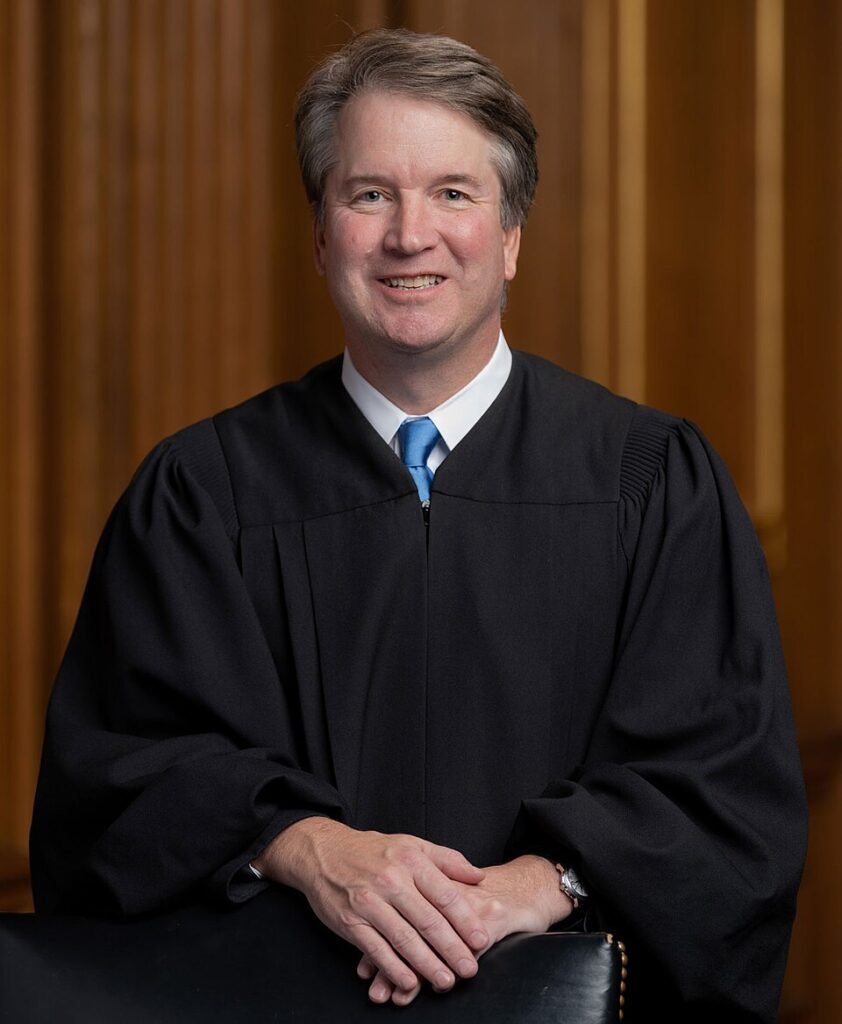
Brett Kavanaugh
Judicial Details
Education
Personal Details
Contact Information
Additional Resources
Status
Basic Information
Supreme Court Justice Brett M. Kavanaugh
When Brett M. Kavanaugh took his seat on the Supreme Court in October 2018, he did so amid one of the most contentious confirmation battles in modern American history. Yet beyond the drama that marked his elevation, Supreme Court Justice Brett M. Kavanaugh arrived with a lengthy paper trail: decades in public service, a dozen years on the nation’s second most powerful court, and a reputation as a careful, methodical conservative jurist with deep roots in executive-branch law.
To understand Supreme Court Justice Brett M. Kavanaugh is to trace the arc of a lawyer shaped by Washington institutions—Catholic education, elite clerkships, the independent counsel era, the Bush White House, and the D.C. Circuit—and to see how those experiences converged on the nation’s highest court.
Early Life and Education
Brett Michael Kavanaugh was born on February 12, 1965, in Washington, D.C., and raised in Bethesda, Maryland. His mother, Martha Kavanaugh, was a prosecutor and later a state trial judge in Maryland; his father, Edward Kavanaugh, worked as a trade association executive. Law and public life were not abstractions in the Kavanaugh household—they were daily realities.
Kavanaugh attended Georgetown Preparatory School, a Jesuit institution in North Bethesda, where he was known for academic diligence and competitive athletics. He later enrolled at Yale University, graduating in 1987 with a degree in history. His senior thesis examined presidential speeches and political communication, a topic that foreshadowed his later immersion in executive power and constitutional structure.
He then attended Yale Law School, graduating in 1990. At Yale, Brett M. Kavanaugh studied under prominent constitutional scholars and built the foundation for what would become a career focused on separation of powers, administrative law, and the scope of presidential authority.
Clerkships and Early Government Service
Like many future Supreme Court justices, Brett M. Kavanaugh followed the elite clerkship track. He clerked for Judge Walter Stapleton of the U.S. Court of Appeals for the Third Circuit and Judge Alex Kozinski of the Ninth Circuit before clerking for Justice Anthony M. Kennedy during the 1993–94 Supreme Court term.
Clerking for Justice Kennedy left a distinct imprint. Kennedy’s jurisprudence often emphasized liberty interests and constitutional structure, themes that would echo—sometimes subtly, sometimes clearly—in Kavanaugh’s later writing.
In the mid-1990s, Kavanaugh joined the Office of Independent Counsel Kenneth Starr during the investigation into President Bill Clinton. He played a role in drafting portions of the Starr Report, including sections related to potential impeachment. That experience immersed him in questions about executive accountability and constitutional limits.
He later served in the George W. Bush administration, including roles as Associate Counsel to the President and Staff Secretary. As Staff Secretary, Brett M. Kavanaugh was responsible for managing the paper flow to and from the president—a role that required legal precision and close attention to policy details. The position also provided him an intimate view of executive decision-making.
The D.C. Circuit Years
In 2003, President George W. Bush nominated Brett M. Kavanaugh to the U.S. Court of Appeals for the District of Columbia Circuit. After a prolonged confirmation process, the Senate confirmed him in 2006.
Over 12 years on the D.C. Circuit, Brett M. Kavanaugh authored hundreds of opinions. His jurisprudence reflected a strong commitment to textualism and separation of powers. He was often skeptical of expansive interpretations of regulatory authority, particularly in cases involving administrative agencies.
He wrote influential opinions in cases concerning environmental regulation, net neutrality, and executive authority. In administrative law, he questioned aspects of the Chevron doctrine, which instructs courts to defer to reasonable agency interpretations of ambiguous statutes. His skepticism toward broad administrative power would later align with trends in the Supreme Court’s evolving jurisprudence.
Kavanaugh also addressed religious liberty claims, campaign finance issues, and detainee rights. While generally viewed as conservative, his opinions sometimes reflected careful parsing of precedent rather than sweeping ideological declarations.
Nomination to the Supreme Court
In July 2018, President Donald J. Trump nominated Brett M. Kavanaugh to replace retiring Justice Anthony Kennedy. The nomination quickly became the focal point of national attention.
The confirmation hearings were marked by allegations of sexual misconduct from Christine Blasey Ford and others, which Kavanaugh vehemently denied. The Senate Judiciary Committee held additional hearings, and the FBI conducted a supplemental background investigation. Ultimately, the Senate confirmed Brett M. Kavanaugh by a 50–48 vote—the narrowest margin for a Supreme Court justice in over a century.
The confirmation battle ensured that Supreme Court Justice Brett M. Kavanaugh would begin his tenure under extraordinary scrutiny.
Jurisprudence on the Supreme Court
Since joining the Court, Supreme Court Justice Brett M. Kavanaugh has emerged as a consistent member of its conservative majority. His writing style is structured and analytical, often emphasizing constitutional text, history, and structural principles.
Among the most significant cases in which Brett M. Kavanaugh has participated:
-
Ramos v. Louisiana (2020)
Kavanaugh joined the majority holding that the Sixth Amendment requires unanimous jury verdicts in state criminal trials. -
June Medical Services v. Russo (2020)
He dissented in a case striking down a Louisiana abortion law, signaling his skepticism toward broad interpretations of abortion precedent. -
Bostock v. Clayton County (2020)
Kavanaugh dissented from the Court’s decision holding that Title VII protects employees from discrimination based on sexual orientation and gender identity. -
Dobbs v. Jackson Women’s Health Organization (2022)
Kavanaugh joined the majority opinion overturning Roe v. Wade. In a concurring opinion, he emphasized that the Constitution is neutral on abortion and leaves the issue to elected representatives. -
West Virginia v. Environmental Protection Agency (2022)
He joined the majority limiting the Environmental Protection Agency’s authority under the “major questions” doctrine, reflecting his longstanding skepticism of broad agency power. -
Biden v. Nebraska (2023)
Kavanaugh joined the majority striking down the Biden administration’s student loan forgiveness program, reinforcing limits on executive authority in major economic actions.
Across these cases, Supreme Court Justice Brett M. Kavanaugh has demonstrated a consistent emphasis on textual interpretation, historical understanding, and structural constitutional limits. He has also shown interest in protecting religious liberty claims and strengthening Second Amendment protections.
Judicial Style and Institutional Role
While aligned with the Court’s conservative wing, Brett M. Kavanaugh has occasionally written concurrences that stress moderation and doctrinal clarity. He has emphasized that courts must interpret statutes as written and avoid policy-driven judgments.
Observers note that Kavanaugh often frames opinions in practical terms, discussing real-world implications and the importance of clear rules. His opinions frequently cite historical sources and prior precedent, reflecting his training in constitutional structure.
Personal Life
Brett M. Kavanaugh married Ashley Estes, a former aide in the George W. Bush administration, in 2004. The couple has two daughters and resides in Maryland. Kavanaugh is known among colleagues for coaching youth sports and maintaining ties to his Washington-area roots.
Despite the turbulence surrounding his confirmation, Supreme Court Justice Brett M. Kavanaugh has maintained a relatively reserved public presence, speaking primarily through judicial opinions and occasional public lectures.
Legacy in Formation
The legacy of Supreme Court Justice Brett M. Kavanaugh remains in progress. He joined the Court at a time of ideological realignment, contributing to decisions that have reshaped abortion law, administrative power, environmental regulation, and executive authority.
His jurisprudence reflects continuity with conservative legal thought that emphasizes textual fidelity, separation of powers, and skepticism toward expansive administrative governance. Yet like all justices, his full impact will be measured not only by individual opinions but by how those decisions shape constitutional law over decades.
In a Court increasingly central to American political life, Brett M. Kavanaugh stands as a pivotal figure in defining the boundaries between elected branches and the judiciary.
References (APA Style)
Biden v. Nebraska, 600 U.S. ___ (2023).
Bostock v. Clayton County, 590 U.S. ___ (2020).
Dobbs v. Jackson Women’s Health Organization, 597 U.S. ___ (2022).
June Medical Services v. Russo, 591 U.S. ___ (2020).
Ramos v. Louisiana, 590 U.S. ___ (2020).
West Virginia v. Environmental Protection Agency, 597 U.S. ___ (2022).
Supreme Court of the United States. (n.d.). Biographies of the Justices: Brett M. Kavanaugh.
Greenhouse, L. (2012). The U.S. Supreme Court: A very short introduction. Oxford University Press.
Toobin, J. (2007). The nine: Inside the secret world of the Supreme Court. Doubleday.