
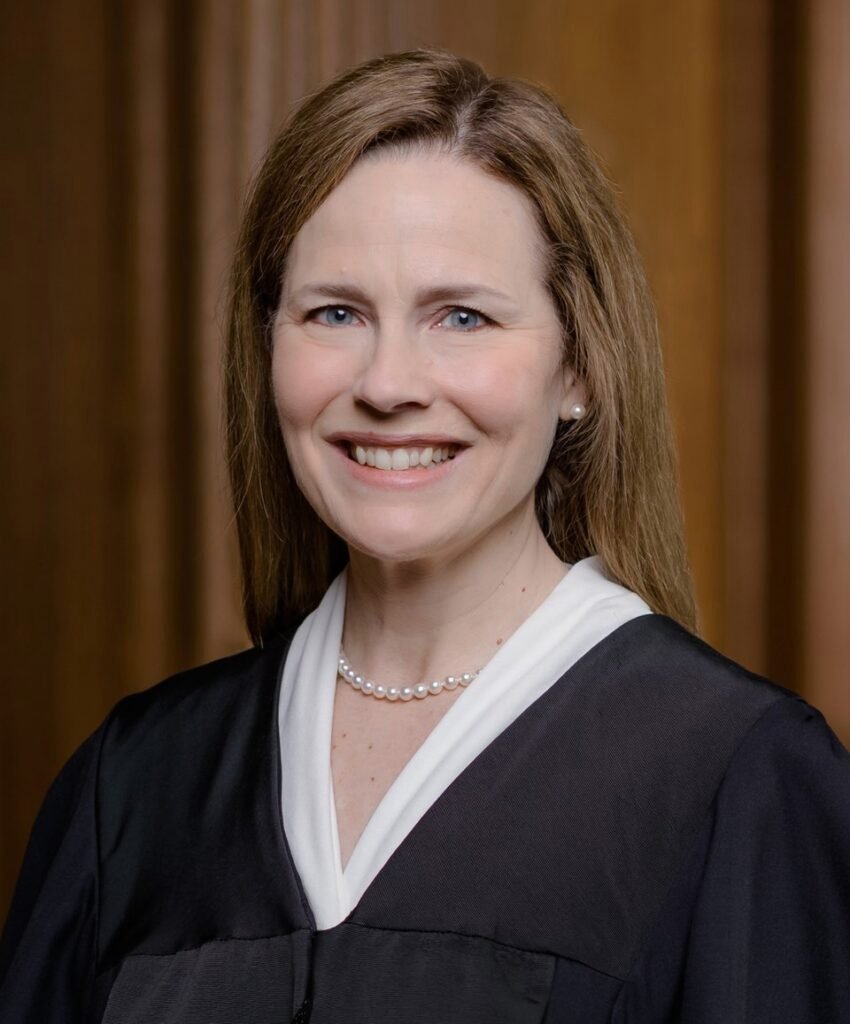
Amy Coney Barrett
Judicial Details
Education
Personal Details
Contact Information
Additional Resources
Status
Basic Information
Amy Coney Barrett has spent her career moving through some of the country’s most influential legal institutions while maintaining the demeanor of a professor—precise, prepared, and notably unshowy. Elevated to the Supreme Court in 2020 after a brief tenure on the U.S. Court of Appeals for the Seventh Circuit, Justice Amy Coney Barrett arrived on the nation’s highest court with an academic’s résumé, an originalist reputation associated with her former boss Antonin Scalia, and the political storm that now accompanies nearly every Supreme Court nomination.
Amy Vivian Coney Barrett was born on January 28, 1972, in New Orleans, Louisiana. She later attended Rhodes College in Memphis, graduating magna cum laude in 1994. She then enrolled at Notre Dame Law School, where she graduated summa cum laude in 1997 and received the Hoynes Prize, an award Notre Dame reserves for the student with the strongest record across scholarship and conduct.
After law school, Amy Coney Barrett followed a well-worn path for elite young lawyers: clerkships that function as apprenticeships in power. She clerked for Judge Laurence H. Silberman on the U.S. Court of Appeals for the D.C. Circuit and then for Justice Antonin Scalia at the Supreme Court. Those experiences—particularly the year with Scalia—became foundational to the public understanding of her judicial method: close attention to text, skepticism of free-floating judicial policy preferences, and an insistence that courts should not revise statutes to fit contemporary sensibilities.
Barrett entered private practice in Washington, then returned to Notre Dame and built the sort of academic career that rarely translates so quickly into a Supreme Court seat. She joined the Notre Dame faculty in the early 2000s and became known for teaching and writing in constitutional law, federal courts, and statutory interpretation—fields that sit at the center of the Supreme Court’s day-to-day work. In other words, Justice Amy Coney Barrett did not merely study the Court; she trained future lawyers in the habits the Court rewards: careful reading, disciplined argument, and an eye for how doctrine behaves once it leaves the classroom and collides with real disputes.
Her transition from professor to judge came in the Trump era. President Donald Trump nominated her to the U.S. Court of Appeals for the Seventh Circuit, and the Senate confirmed her on October 31, 2017 (55–43). The appellate tenure was short but intense—a compressed audition for higher office. Three years later, after the death of Justice Ruth Bader Ginsburg, Trump nominated Barrett to the Supreme Court. The Senate confirmed her on October 26, 2020, and she joined the Court as the 115th Associate Justice.
On the Supreme Court, Justice Amy Coney Barrett has sometimes been described as a reliable conservative vote, but that summary is too blunt to be useful. Her writing style tends toward clean lines and straightforward logic, and her votes—while often aligned with the Court’s conservative bloc—have also reflected an institutionalist streak: an interest in process, limits, and the Court’s own role. That mix shows up most clearly when she writes for the Court.
Important cases involving Amy Coney Barrett
Below are several major Supreme Court matters in which Amy Coney Barrett played a significant role, either by authoring the Court’s opinion or joining a consequential majority:
Opinions authored by Justice Amy Coney Barrett
-
United States Fish & Wildlife Service v. Sierra Club (2021) — Her first majority opinion as a justice, addressing when agency documents qualify as “final” for disclosure under the Freedom of Information Act.
-
Goldman Sachs Group, Inc. v. Arkansas Teacher Retirement System (2021) — A high-impact securities case clarifying how courts assess “price impact” at the class-certification stage in Rule 10b-5 litigation.
-
United States v. Hansen (2023) — A case involving the First Amendment and a federal immigration statute that criminalizes “encouraging or inducing” unlawful immigration; the Court rejected an overbreadth ruling by the Ninth Circuit.
-
Corner Post, Inc. v. Board of Governors of the Federal Reserve System (2024) — A major administrative-law ruling on when a claim “accrues” for statute-of-limitations purposes under the default limitations period for suits against the United States.
-
Medical Marijuana, Inc. v. Horn (2025) — A closely watched civil RICO decision holding that economic harms to “business or property” can be recoverable even when they stem from a personal injury.
-
Trump v. CASA, Inc. (2025) — An opinion addressing the scope of federal courts’ equitable authority and the legitimacy of “universal injunctions.”
Landmark case where she joined the majority
-
Dobbs v. Jackson Women’s Health Organization (2022) — Barrett joined the majority that overturned Roe v. Wade and Planned Parenthood v. Casey, returning abortion regulation to elected branches.
Taken together, these cases show what has become the through-line of the Amy Coney Barrett era: a jurist attentive to doctrinal structure (especially in administrative law and statutory interpretation), willing to write in controversial areas, and comfortable narrowing broad legal theories to what she views as their textual and historical foundations.
References
Barrett, A. C. (2021, March 4). United States Fish and Wildlife Service v. Sierra Club, Inc., No. 19–547 (Opinion of the Court). Supreme Court of the United States.
Barrett, A. C. (2021, June 21). Goldman Sachs Group, Inc. v. Arkansas Teacher Retirement System, No. 20–222 (Opinion of the Court). Supreme Court of the United States.
Barrett, A. C. (2023, June 23). United States v. Hansen, No. 22–179 (Opinion of the Court). Supreme Court of the United States.
Barrett, A. C. (2024, July 1). Corner Post, Inc. v. Board of Governors of the Federal Reserve System, No. 22–1008 (Opinion of the Court). Supreme Court of the United States.
Barrett, A. C. (2025, April 2). Medical Marijuana, Inc. v. Horn, No. 23–365 (Opinion of the Court). Supreme Court of the United States.
Barrett, A. C. (2025, June 27). Trump v. CASA, Inc., No. 24A884 (Opinion of the Court). Supreme Court of the United States.
Congressional Research Service. (2020). Judge Amy Coney Barrett (LSB10539). Congress.gov.
Notre Dame Law School. (n.d.). Amy Coney Barrett (Faculty profile).
Supreme Court Historical Society. (n.d.). The Current Court: Justice Amy Coney Barrett.
U.S. Senate. (2017, October 31). Roll Call Vote 115th Congress – 1st Session, Vote No. 255 (Barrett confirmation to the Seventh Circuit).