
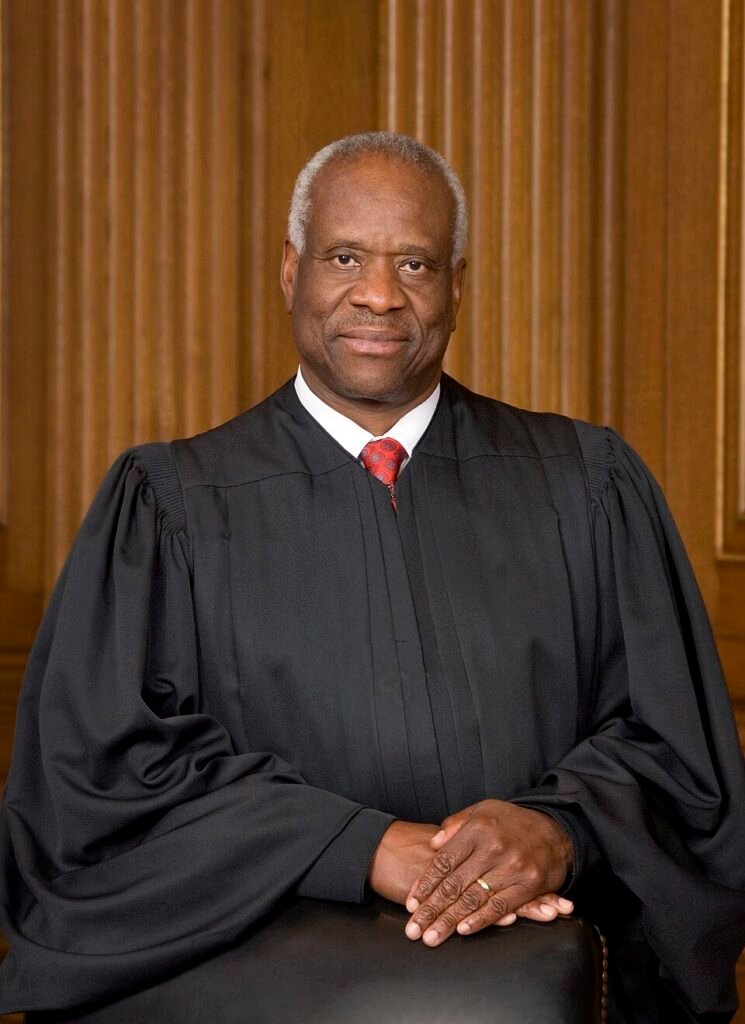
Clarence Thomas
Judicial Details
Education
Personal Details
Contact Information
Additional Resources
Status
Basic Information
Supreme Court Justice Clarence Thomas
When Clarence Thomas took his seat on the Supreme Court of the United States in October 1991, he became only the second African American justice in the Court’s history. More than three decades later, Supreme Court Justice Clarence Thomas stands as its longest-serving current member and one of its most consequential—and controversial—figures. His jurisprudence, rooted in originalism and a deep skepticism of expansive federal power, has shaped constitutional law in areas ranging from gun rights to affirmative action, from administrative authority to free speech.
To understand Supreme Court Justice Clarence Thomas is to trace a life that began in poverty in the segregated South and culminated in one of the most powerful judicial offices in the world.
Early Life in Georgia
Clarence Thomas was born on June 23, 1948, in Pin Point, a small, predominantly Black community near Savannah, Georgia. His father left the family when Thomas was a toddler. After a house fire displaced them, Thomas and his younger brother were sent to live with their maternal grandparents in Savannah.
His grandfather, Myers Anderson, a small business owner, became a central influence in Thomas’s life. A man of discipline and high expectations, Anderson instilled in his grandson the values of hard work, self-reliance, and religious faith.
Thomas attended Catholic schools, including St. Pius X High School and later St. John Vianney Minor Seminary, with early aspirations of becoming a priest. The civil rights movement and racial unrest of the 1960s shaped his formative years. Disillusioned after the assassination of Martin Luther King Jr., Thomas left the seminary path.
He enrolled at the College of the Holy Cross in Massachusetts, graduating in 1971 with a degree in English literature. During his time there, Thomas became active in student protest movements and developed an interest in political philosophy.
He then attended Yale Law School, earning his Juris Doctor in 1974. Although he later spoke critically of aspects of his experience there, Yale provided Thomas with formal legal training and entry into elite legal circles.
Early Career and Public Service
After law school, Clarence Thomas initially struggled to secure employment, attributing difficulties to perceptions about affirmative action. He ultimately found a position as an assistant attorney general in Missouri under then–Attorney General John Danforth.
Thomas later worked in private practice and returned to government service in Washington. In 1981, President Ronald Reagan appointed him Assistant Secretary for Civil Rights at the Department of Education. The following year, he became Chairman of the Equal Employment Opportunity Commission (EEOC), a position he held from 1982 to 1990.
As EEOC Chairman, Thomas emphasized enforcement of existing civil rights laws while advocating for a narrower interpretation of affirmative action policies. His tenure drew both praise and criticism, particularly regarding his views on race-conscious remedies.
Federal Appellate Appointment
In 1990, President George H. W. Bush nominated Clarence Thomas to the U.S. Court of Appeals for the District of Columbia Circuit. The Senate confirmed him after contentious debate. His time on the D.C. Circuit was brief—just over a year—but it placed him in consideration for higher office.
Nomination to the Supreme Court
In July 1991, President Bush nominated Clarence Thomas to succeed Justice Thurgood Marshall, the Court’s first African American justice. The nomination triggered one of the most dramatic confirmation battles in modern history.
During Senate hearings, law professor Anita Hill accused Thomas of sexual harassment during his tenure at the EEOC. Thomas categorically denied the allegations, describing the proceedings as a “high-tech lynching.” The Senate confirmed him by a narrow vote of 52–48.
The confirmation battle left a lasting imprint on the nation’s political culture and on Justice Clarence Thomas himself.
Jurisprudence on the Supreme Court
Over more than three decades, Supreme Court Justice Clarence Thomas has built one of the most consistent originalist records on the Court. His opinions often call for reconsideration of precedent and a return to what he views as the Constitution’s original public meaning.
Among the most significant cases involving Supreme Court Justice Clarence Thomas:
Bush v. Gore (2000)
Thomas joined the majority halting Florida’s recount during the 2000 presidential election, effectively resolving the election in favor of George W. Bush.District of Columbia v. Heller (2008)
He joined the majority recognizing an individual right to bear arms under the Second Amendment. Thomas later wrote separately in related cases advocating for incorporation of the Second Amendment against the states.Citizens United v. Federal Election Commission (2010)
Thomas joined the majority expanding First Amendment protections for corporate political expenditures and wrote separately criticizing disclosure requirements.Shelby County v. Holder (2013)
He joined the majority striking down part of the Voting Rights Act and wrote separately suggesting that additional provisions might also be unconstitutional.Obergefell v. Hodges (2015)
Thomas dissented from the decision recognizing same-sex marriage as a constitutional right, arguing that the Due Process Clause protects liberty from government interference but does not confer entitlements.Dobbs v. Jackson Women’s Health Organization (2022)
Justice Clarence Thomas joined the majority opinion overturning Roe v. Wade. In a concurring opinion, he suggested reconsideration of other substantive due process precedents.
Across these and numerous other cases, Supreme Court Justice Clarence Thomas has consistently advocated for originalist constitutional interpretation and skepticism toward expansive readings of federal authority.
Judicial Philosophy
Justice Clarence Thomas is widely regarded as one of the Court’s most committed originalists. He frequently emphasizes the Constitution’s text and historical context, often citing founding-era sources.
He has also expressed skepticism toward the doctrine of stare decisis when precedent conflicts with original meaning. His concurring and dissenting opinions frequently invite reconsideration of established doctrines in areas such as administrative law, affirmative action, and substantive due process.
Unlike some colleagues, Thomas is known for rarely speaking during oral arguments. However, his written opinions are detailed and historically grounded.
Public Scrutiny and Controversies
In recent years, Justice Clarence Thomas has faced scrutiny regarding ethics and financial disclosures, particularly involving travel and relationships with wealthy benefactors. These controversies have intensified debates over Supreme Court ethics standards.
Thomas has defended his conduct and continued to emphasize judicial independence.
Personal Life
Clarence Thomas married Virginia “Ginni” Thomas in 1987. Ginni Thomas is a conservative activist who has been active in political advocacy. Their public roles have occasionally intersected with broader political controversies.
Justice Thomas has spoken publicly about his personal journey, including in his memoir, My Grandfather’s Son, which recounts his upbringing and confirmation experience.
Legacy
The legacy of Supreme Court Justice Clarence Thomas is defined by doctrinal consistency and constitutional ambition. He has reshaped Second Amendment jurisprudence, influenced affirmative action doctrine, and played a central role in the Court’s reconsideration of abortion precedent.
Whether praised as a principled originalist or criticized for destabilizing precedent, Clarence Thomas remains one of the most influential justices of his era.
From Pin Point, Georgia, to the marble halls of the Supreme Court, his life reflects a journey shaped by resilience, ideology, and enduring impact on American constitutional law.
References (APA Style)
Bush v. Gore, 531 U.S. 98 (2000).
Citizens United v. Federal Election Commission, 558 U.S. 310 (2010).
District of Columbia v. Heller, 554 U.S. 570 (2008).
Dobbs v. Jackson Women’s Health Organization, 597 U.S. ___ (2022).
Obergefell v. Hodges, 576 U.S. 644 (2015).
Shelby County v. Holder, 570 U.S. 529 (2013).
Thomas, C. (2007). My grandfather’s son. HarperCollins.
Supreme Court of the United States. (n.d.). Biographies of the Justices: Clarence Thomas.