
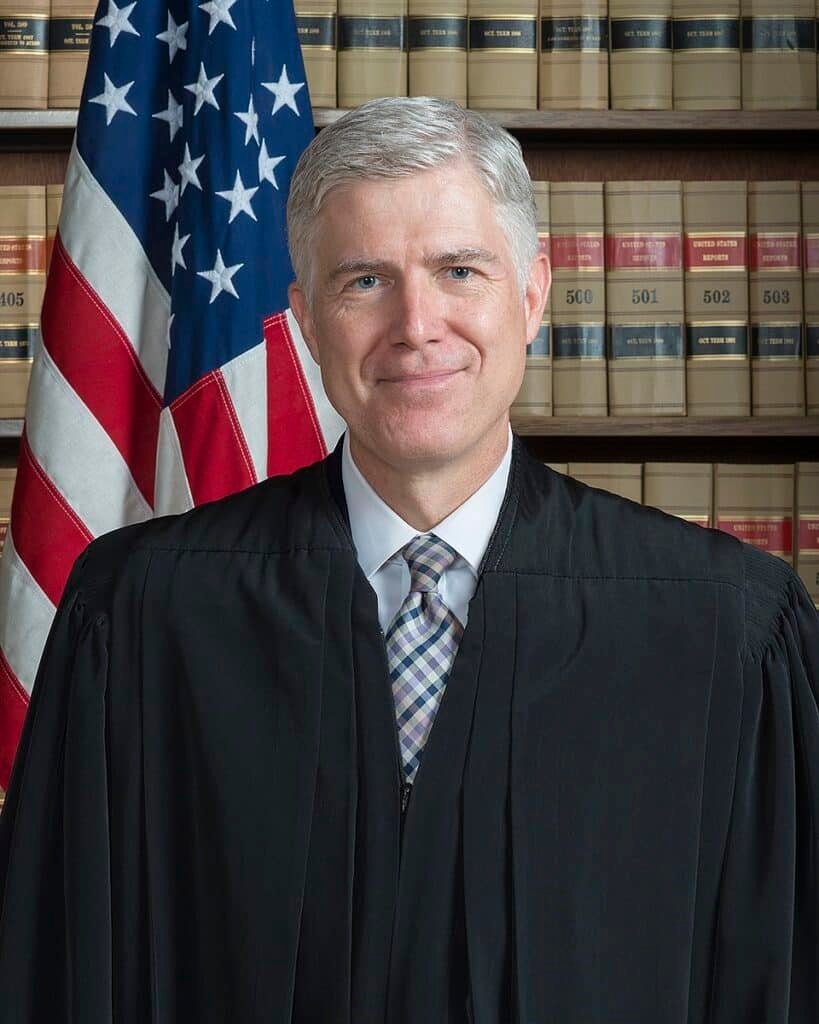
Neil Gorsuch
Judicial Details
Education
Personal Details
Contact Information
Status
Basic Information
Supreme Court Justice Neil M. Gorsuch
When Neil M. Gorsuch took his oath as an Associate Justice of the Supreme Court of the United States in April 2017, he filled a seat left vacant for more than a year following the death of Justice Antonin Scalia. The vacancy had become a political flashpoint, but the man who ultimately assumed the role brought with him a distinct judicial identity—deeply textualist, attentive to history, protective of individual liberty, and at times willing to surprise ideological allies.
Supreme Court Justice Neil M. Gorsuch has built a jurisprudence rooted in constitutional structure and statutory clarity. Yet his career, stretching from the Colorado plains to Oxford classrooms to the federal appellate bench, reflects not just ideological alignment but intellectual independence.
Early Life and Education
Neil McGill Gorsuch was born on August 29, 1967, in Denver, Colorado. His mother, Anne Gorsuch Burford, served as Administrator of the Environmental Protection Agency under President Ronald Reagan. His father, David Gorsuch, was an attorney. Public service and law were central themes of his upbringing.
Gorsuch attended Georgetown Preparatory School in Maryland before enrolling at Columbia University, where he graduated in 1988 with a degree in political science. At Columbia, he demonstrated strong academic performance and interest in legal theory.
He then attended Harvard Law School, earning his Juris Doctor in 1991. At Harvard, Gorsuch served as an editor of the Harvard Journal of Law & Public Policy and studied alongside future members of the legal elite.
Following Harvard, Neil M. Gorsuch earned a Doctor of Philosophy in legal philosophy from Oxford University as a Marshall Scholar. His doctoral work focused on assisted suicide and euthanasia, later published as The Future of Assisted Suicide and Euthanasia. The work explored moral philosophy, individual autonomy, and the state’s interest in preserving life—issues that would later surface in constitutional litigation.
Clerkships and Early Legal Career
After completing law school, Gorsuch clerked for Judge David Sentelle of the U.S. Court of Appeals for the District of Columbia Circuit and then for Justices Byron White and Anthony Kennedy of the Supreme Court. These clerkships exposed him to a broad spectrum of judicial reasoning and constitutional interpretation.
Gorsuch entered private practice at Kellogg, Huber, Hansen, Todd, Evans & Figel in Washington, D.C., where he specialized in appellate litigation. His practice involved complex federal regulatory and constitutional cases, reinforcing his expertise in statutory interpretation.
In 2005, he joined the U.S. Department of Justice as Principal Deputy Associate Attorney General. In that role, he supervised civil litigation and regulatory matters, gaining firsthand experience in executive-branch legal administration.
The Tenth Circuit Years
In 2006, President George W. Bush nominated Neil M. Gorsuch to the U.S. Court of Appeals for the Tenth Circuit. The Senate confirmed him unanimously.
During his tenure on the Tenth Circuit, Gorsuch developed a reputation as a careful writer with a strong commitment to textualism. His opinions frequently emphasized the plain meaning of statutes and constitutional provisions.
He also began articulating skepticism toward the Chevron doctrine, which instructs courts to defer to administrative agencies’ interpretations of ambiguous statutes. In separate writings, Gorsuch questioned whether such deference was consistent with the judiciary’s constitutional role.
His Tenth Circuit opinions addressed issues ranging from criminal procedure to religious liberty. Notably, he joined the majority in Hobby Lobby Stores, Inc. v. Sebelius, which held that closely held corporations could claim religious exemptions under the Religious Freedom Restoration Act. The Supreme Court later affirmed that decision.
Nomination to the Supreme Court
In January 2017, President Donald J. Trump nominated Neil M. Gorsuch to the Supreme Court. The nomination followed a year-long vacancy after the Senate declined to consider President Barack Obama’s nominee, Merrick Garland.
The confirmation process was contentious. Senate Democrats mounted a filibuster, leading Republicans to invoke the so-called “nuclear option,” eliminating the filibuster for Supreme Court nominations. The Senate confirmed Gorsuch by a vote of 54–45.
At age 49, Supreme Court Justice Neil M. Gorsuch became one of the youngest members of the Court in recent history.
Jurisprudence on the Supreme Court
Since joining the Court, Justice Neil Gorsuch has established himself as a consistent textualist and originalist, though not always predictably aligned with partisan expectations.
Among the most significant cases involving Supreme Court Justice Neil M. Gorsuch:
Bostock v. Clayton County (2020)
In a decision that surprised many observers, Gorsuch authored the majority opinion holding that Title VII prohibits employment discrimination based on sexual orientation and gender identity. His reasoning relied strictly on statutory text, concluding that discrimination “because of sex” necessarily encompassed such claims.McGirt v. Oklahoma (2020)
Gorsuch wrote the majority opinion holding that much of eastern Oklahoma remains Native American reservation land for purposes of federal criminal law. The ruling emphasized treaty obligations and congressional authority.Ramos v. Louisiana (2020)
He authored the opinion requiring unanimous jury verdicts in state criminal trials, grounding the decision in original constitutional understanding.West Virginia v. Environmental Protection Agency (2022)
Gorsuch wrote a concurring opinion elaborating on the “major questions” doctrine, arguing that significant regulatory actions require clear congressional authorization.Dobbs v. Jackson Women’s Health Organization (2022)
Justice Neil Gorsuch joined the majority opinion overturning Roe v. Wade, aligning with a historical interpretation of constitutional rights.Kennedy v. Bremerton School District (2022)
He joined the majority siding with a high school football coach who prayed on the field, emphasizing free exercise protections.
Across these cases, Supreme Court Justice Neil M. Gorsuch has consistently prioritized textual clarity and historical analysis. His approach often rejects balancing tests in favor of bright-line rules grounded in constitutional text.
Judicial Philosophy
Justice Neil Gorsuch is widely described as an originalist and textualist in the mold of Justice Scalia. He frequently emphasizes that judges must interpret statutes as written and avoid substituting policy preferences.
At the same time, his opinions reflect a libertarian streak. He has sided with criminal defendants in cases involving procedural protections and has defended Native American treaty rights with unusual vigor among conservative jurists.
Gorsuch’s skepticism of administrative deference has placed him at the forefront of a broader judicial shift limiting federal agency authority.
Writing Style and Public Engagement
Justice Gorsuch’s writing style is direct and occasionally literary. His opinions often employ historical narrative and rhetorical clarity. He has also authored books, including A Republic, If You Can Keep It, which discusses the Constitution and civic responsibility.
Though reserved in public commentary, Gorsuch participates in educational events and lectures emphasizing constitutional literacy.
Personal Life
Neil M. Gorsuch is married to Louise Gorsuch, and the couple has two daughters. They maintain ties to Colorado and Washington, D.C. Colleagues describe him as collegial and deeply prepared for oral argument.
Legacy
The legacy of Supreme Court Justice Neil M. Gorsuch continues to evolve. He has played a central role in reshaping administrative law, criminal procedure, tribal sovereignty, and civil rights interpretation.
His authorship of Bostock and McGirt illustrates a jurist guided by textual consistency rather than predictable ideological alignment. At the same time, his votes in cases such as Dobbs reflect a commitment to originalist constitutional reasoning.
In an era of intense polarization, Justice Neil Gorsuch remains a figure whose jurisprudence is defined less by partisan label than by interpretive method.
References (APA Style)
Bostock v. Clayton County, 590 U.S. ___ (2020).
Dobbs v. Jackson Women’s Health Organization, 597 U.S. ___ (2022).
Kennedy v. Bremerton School District, 597 U.S. ___ (2022).
McGirt v. Oklahoma, 591 U.S. ___ (2020).
Ramos v. Louisiana, 590 U.S. ___ (2020).
West Virginia v. Environmental Protection Agency, 597 U.S. ___ (2022).
Gorsuch, N. M. (2006). The future of assisted suicide and euthanasia. Princeton University Press.
Supreme Court of the United States. (n.d.). Biographies of the Justices: Neil M. Gorsuch.