
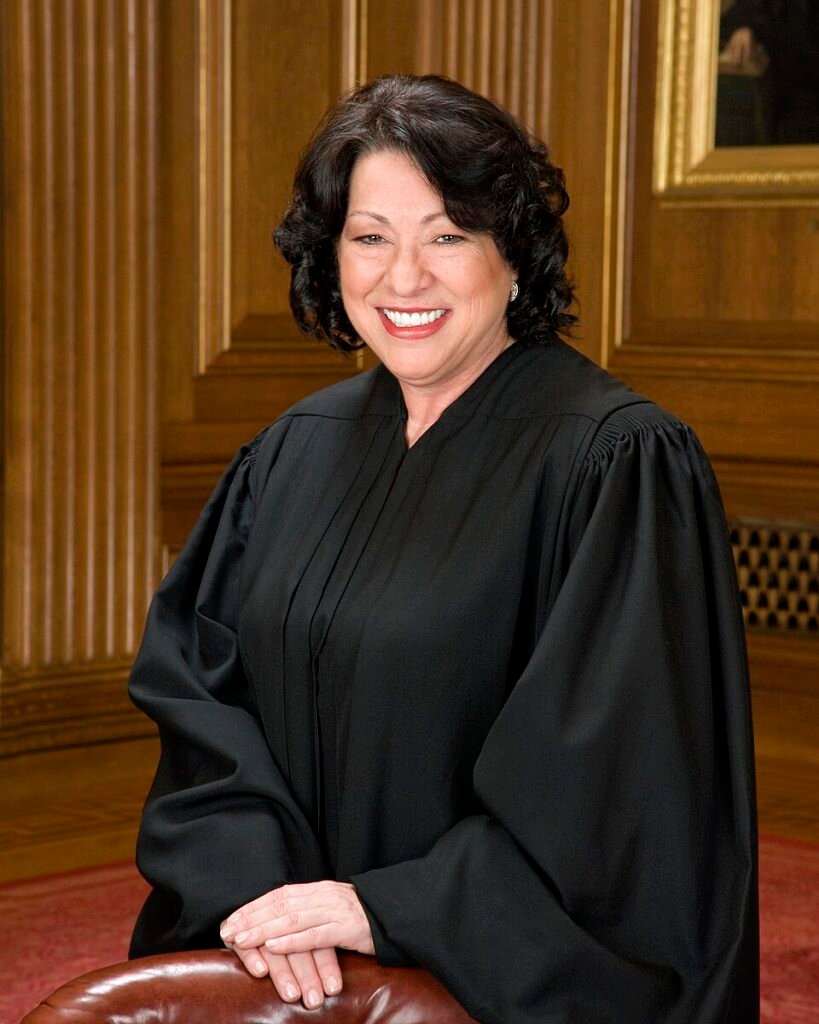
Sonia Sotomayor
Judicial Details
Education
Personal Details
Contact Information
Additional Resources
Status
Basic Information
Supreme Court Justice Sonia Sotomayor
When Sonia Sotomayor took her seat on the Supreme Court in August 2009, she became the first Latina justice in American history and only the third woman ever appointed to the nation’s highest court. Yet to define Supreme Court Justice Sonia Sotomayor solely by biography would be to miss the broader arc of her judicial influence. Over more than a decade on the bench, Justice Sonia Sotomayor has established herself as a powerful voice on civil rights, criminal justice, voting access, and the lived realities of constitutional law.
Her story is one of discipline and ascent—rooted in the Bronx, refined in elite academic institutions, shaped by prosecutorial rigor, and ultimately defined by a jurisprudence that often centers the human consequences of legal doctrine.
Early Life in the Bronx
Sonia Maria Sotomayor was born on June 25, 1954, in the Bronx, New York, to Puerto Rican parents who had migrated to the mainland United States during the postwar years. Her father, Juan Sotomayor, worked as a tool-and-die worker, and her mother, Celina Sotomayor, served as a nurse and later as an administrative employee. The family lived in a housing project in the South Bronx.
When Sotomayor was nine years old, her father died of heart complications. Her mother, determined that education would serve as a ladder out of hardship, emphasized academic achievement. Diagnosed with Type 1 diabetes as a child, Sonia Sotomayor learned early the discipline of daily insulin injections and self-management—traits she has described as formative in her character.
She attended Cardinal Spellman High School in the Bronx, graduating as valedictorian. She then enrolled at Princeton University, entering a campus where few students shared her socioeconomic or cultural background. At Princeton, Sonia Sotomayor thrived academically while also engaging in student activism and leadership, particularly around issues affecting Latino students. She graduated summa cum laude in 1976 and received the Pyne Prize, the university’s highest undergraduate honor.
From Princeton, Sotomayor went to Yale Law School, earning her Juris Doctor in 1979. At Yale, she served as an editor of the Yale Law Journal and developed a growing interest in litigation and public service.
Early Legal Career: Prosecutor and Private Practice
After law school, Sonia Sotomayor joined the Manhattan District Attorney’s Office as an assistant district attorney under Robert Morgenthau. For five years, she prosecuted cases ranging from minor offenses to serious felonies. Her experience in criminal prosecution would later inform her understanding of policing, incarceration, and procedural fairness.
In 1984, she entered private practice at Pavia & Harcourt, a firm specializing in commercial litigation and intellectual property. While in private practice, Sotomayor continued to serve on various civic boards, including the New York City Campaign Finance Board.
These early years reveal a pattern that would continue throughout her career: a balance between legal rigor and community engagement.
Federal District Court Appointment
In 1991, President George H. W. Bush nominated Sonia Sotomayor to the U.S. District Court for the Southern District of New York. The Senate confirmed her in 1992.
As a federal trial judge, Sotomayor handled a broad docket that included civil rights cases, intellectual property disputes, and criminal trials. One of her most notable rulings involved Major League Baseball during the 1994 strike, where she issued an injunction that effectively ended the work stoppage and preserved the baseball season.
Her district court tenure showcased her practical courtroom management skills and detailed attention to the factual record—traits that would characterize her appellate work.
The Second Circuit Years
In 1997, President Bill Clinton nominated Sonia Sotomayor to the U.S. Court of Appeals for the Second Circuit. After a delay in the Senate, she was confirmed in 1998.
Over more than a decade on the Second Circuit, Sotomayor authored hundreds of opinions. Her rulings spanned employment discrimination, constitutional criminal procedure, securities regulation, and immigration law.
A widely discussed case from this period was Ricci v. DeStefano, involving claims of reverse discrimination in firefighter promotions in New Haven, Connecticut. The Second Circuit panel, including Sotomayor, upheld the city’s decision to discard promotion exam results. The Supreme Court later reversed that ruling. The case became a focal point during her Supreme Court confirmation hearings.
Nomination to the Supreme Court
In 2009, President Barack Obama nominated Sonia Sotomayor to replace retiring Justice David Souter. During her confirmation hearings, she faced pointed questioning regarding comments she had made about the experiences of a “wise Latina” judge. Sotomayor clarified that her remarks were intended to highlight the value of diverse life experiences, not to elevate identity above law.
The Senate confirmed Supreme Court Justice Sonia Sotomayor by a vote of 68–31. Her appointment marked a historic milestone for representation on the Court.
Jurisprudence on the Supreme Court
Since joining the Court, Justice Sonia Sotomayor has built a record defined by strong dissents, detailed majority opinions, and a consistent focus on civil rights and procedural fairness.
Among the most significant cases involving Supreme Court Justice Sonia Sotomayor:
J.D.B. v. North Carolina (2011)
Sotomayor authored the majority opinion holding that a child’s age must be considered in determining Miranda custody analysis.Utah v. Strieff (2016)
In dissent, she wrote a powerful opinion criticizing the Court’s ruling that allowed evidence obtained after an unlawful stop. Her dissent spoke candidly about the lived experience of minority communities interacting with law enforcement.Trump v. Hawaii (2018)
Sotomayor dissented from the majority decision upholding the Trump administration’s travel restrictions, arguing that the policy was motivated by religious animus.Bostock v. Clayton County (2020)
She joined the majority holding that Title VII protects employees from discrimination based on sexual orientation and gender identity.Dobbs v. Jackson Women’s Health Organization (2022)
Justice Sonia Sotomayor joined the dissent opposing the decision to overturn Roe v. Wade, warning that the ruling undermined decades of precedent and women’s constitutional protections.
Throughout her Supreme Court tenure, Justice Sonia Sotomayor has also written on issues involving immigration enforcement, voting rights, and access to federal courts.
Judicial Philosophy and Style
Supreme Court Justice Sonia Sotomayor is often described as a pragmatist with a deep respect for precedent. While not formally aligned with any single interpretive school, she frequently emphasizes how legal doctrine affects ordinary people.
Her opinions tend to combine doctrinal analysis with real-world awareness. In dissents, she has sometimes adopted a more direct tone than her colleagues, underscoring the human consequences of judicial decisions.
Justice Sonia Sotomayor has also emphasized the importance of experiential perspective, arguing that judges inevitably bring their backgrounds to the bench but remain bound by law and precedent.
Public Engagement and Authorship
Beyond the courtroom, Sonia Sotomayor has become one of the Court’s most publicly engaged justices. She has authored memoirs and children’s books, including My Beloved World, which recounts her journey from the Bronx to the Supreme Court.
She frequently speaks at universities and civic events, encouraging young people—particularly from underrepresented backgrounds—to pursue public service.
Personal Life
Justice Sonia Sotomayor has never remarried after a brief early marriage that ended in divorce. She remains close to her extended family and continues to manage Type 1 diabetes with discipline.
Colleagues describe her as warm, direct, and intellectually rigorous.
Legacy
The legacy of Supreme Court Justice Sonia Sotomayor is defined not only by doctrine but by voice. As the Court has shifted ideologically, her dissents have become increasingly central to legal debate. Whether in majority opinions protecting juvenile rights or dissents defending voting access, she has consistently framed constitutional questions in terms of fairness and equality.
For many Americans, Sonia Sotomayor represents both institutional excellence and expanded representation. For legal scholars, she stands as one of the Court’s most vivid writers and persistent defenders of civil rights.
Her career continues to unfold, but her imprint on American jurisprudence is already unmistakable.
References (APA Style)
Bostock v. Clayton County, 590 U.S. ___ (2020).
Dobbs v. Jackson Women’s Health Organization, 597 U.S. ___ (2022).
J.D.B. v. North Carolina, 564 U.S. 261 (2011).
Trump v. Hawaii, 585 U.S. ___ (2018).
Utah v. Strieff, 579 U.S. 232 (2016).
Sotomayor, S. (2013). My beloved world. Knopf.
Supreme Court of the United States. (n.d.). Biographies of the Justices: Sonia Sotomayor.