
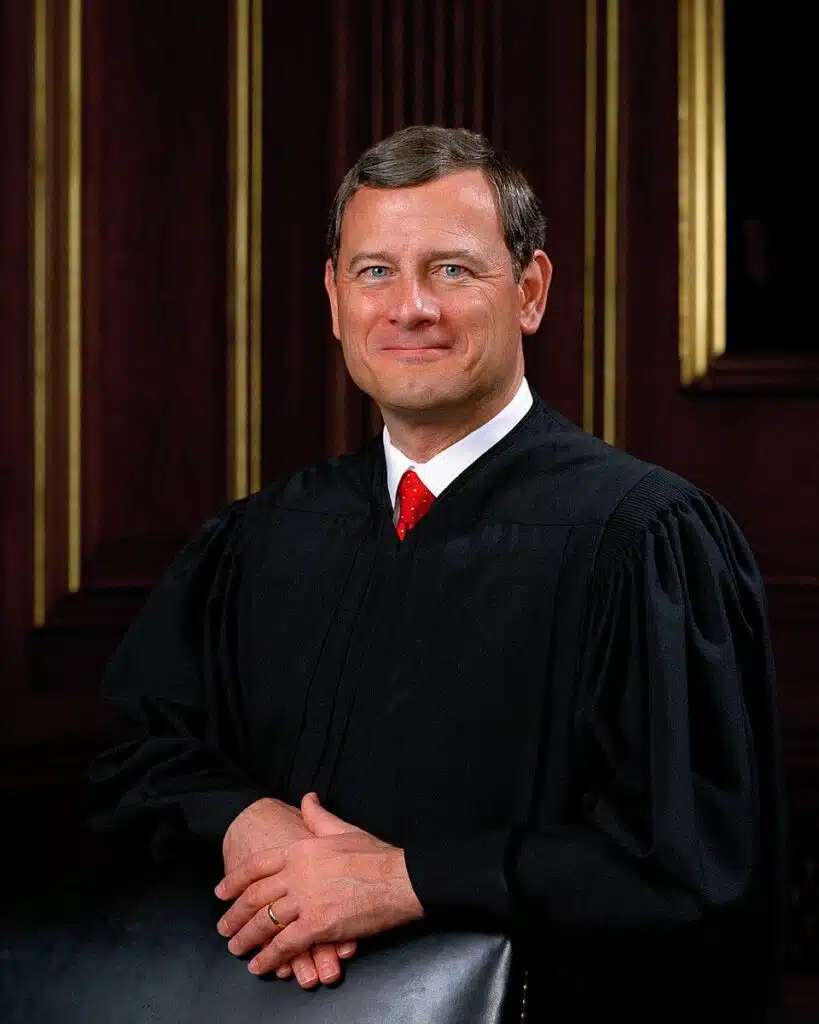
John G Roberts
Judicial Details
Education
Personal Details
Contact Information
Additional Resources
Status
Basic Information
Supreme Court Justice John G Roberts Jr.
When John G. Roberts Jr. took the oath as Chief Justice of the United States in September 2005, he was just 50 years old—young by Supreme Court standards, meticulously credentialed, and stepping into the center chair at a moment of constitutional transition. Over the next two decades, Chief Justice John G. Roberts Jr. would preside over a Court that confronted seismic questions about health care, voting rights, same-sex marriage, executive power, abortion, religious liberty, and the scope of the administrative state.
To understand John G. Roberts Jr. is to understand both a lawyer shaped by elite institutions and a jurist who sees himself, above all, as a guardian of the Court’s institutional legitimacy.
Early Life and Education
John Glover Roberts Jr. was born on January 27, 1955, in Buffalo, New York, and raised in Long Beach, Indiana. His father worked as an executive in the steel industry, and his mother was active in parish and civic life. Roberts attended La Lumiere School, a Catholic boarding school in Indiana, where he distinguished himself academically and developed a reputation for discipline and seriousness of purpose.
He enrolled at Harvard College, graduating summa cum laude in 1976 with a degree in history. His undergraduate thesis examined British liberalism in the 19th century—a study in constitutional governance and restraint that, in hindsight, reads almost like a prelude to his judicial career. He then attended Harvard Law School, where he served as managing editor of the Harvard Law Review and graduated magna cum laude in 1979.
From the outset, John G. Roberts Jr. followed the traditional path of a lawyer bound for the highest reaches of the judiciary. He clerked first for Judge Henry Friendly of the U.S. Court of Appeals for the Second Circuit, one of the most respected jurists of the 20th century. He then clerked for then–Associate Justice William H. Rehnquist during the Supreme Court’s 1980–81 term. Both mentors influenced Roberts’ understanding of federalism, textualism, and the structural Constitution.
Early Career in Government and Advocacy
After his clerkships, Roberts entered private practice before joining the Reagan administration in 1982 as Special Assistant to the Attorney General. He later served as Associate Counsel to President Ronald Reagan. In those roles, Roberts worked on legal policy questions ranging from civil rights enforcement to the balance of power between Congress and the executive branch.
In 1989, he became Principal Deputy Solicitor General under President George H. W. Bush. There, John G. Roberts Jr. argued 39 cases before the Supreme Court. His performance as an advocate was widely praised. Colleagues described him as unfailingly prepared, careful with language, and respectful of the Court’s institutional role. His arguments were rarely theatrical; instead, they reflected technical mastery and structural reasoning.
Throughout the 1990s, Roberts returned to private practice at Hogan & Hartson (now Hogan Lovells), where he led the firm’s appellate practice. He became one of Washington’s most sought-after Supreme Court advocates, arguing complex cases involving administrative law, business regulation, and constitutional interpretation.
The D.C. Circuit and Nomination to the Supreme Court
In 2003, President George W. Bush nominated John G. Roberts Jr. to the U.S. Court of Appeals for the District of Columbia Circuit. The Senate confirmed him, and he began serving on what is often called the nation’s second most powerful court. His tenure there was brief but closely examined. Roberts authored relatively few opinions, but those he did write revealed a jurist attentive to statutory text and skeptical of expansive judicial intervention.
In 2005, after the retirement announcement of Justice Sandra Day O’Connor, President Bush initially nominated Roberts to fill her seat. But following the death of Chief Justice William H. Rehnquist, Bush shifted course and nominated Roberts to serve as Chief Justice of the United States. The Senate confirmed him by a vote of 78–22.
At 50, John G. Roberts Jr. became the 17th Chief Justice in American history.
Judicial Philosophy
Chief Justice John G. Roberts Jr. has often described judges as “umpires,” tasked with calling balls and strikes rather than shaping policy. While critics argue that no justice is purely mechanical in decision-making, Roberts has consistently emphasized judicial modesty, institutional restraint, and incrementalism.
Though generally aligned with conservative jurisprudence—particularly in areas like federalism, campaign finance, and religious liberty—Roberts has occasionally diverged from more ideologically driven outcomes when he perceives risks to the Court’s legitimacy. This institutional instinct has made him, at times, both a pivotal vote and a solitary dissenter.
Major Cases
Chief Justice John G. Roberts Jr. has authored or shaped opinions in many of the Court’s most consequential cases of the 21st century.
National Federation of Independent Business v. Sebelius (2012)
Roberts authored the majority opinion upholding the Affordable Care Act’s individual mandate under Congress’s taxing power. While rejecting the Commerce Clause rationale advanced by the government, he concluded that the mandate could survive as a tax. The ruling preserved President Obama’s signature domestic policy achievement and underscored Roberts’ institutional caution.Shelby County v. Holder (2013)
Writing for the majority, Roberts struck down the Voting Rights Act’s coverage formula, holding that it no longer reflected current conditions. The decision reshaped federal oversight of state election laws.Citizens United v. Federal Election Commission (2010)
Roberts joined the majority expanding First Amendment protections for corporate political expenditures. The decision significantly altered campaign finance law.Obergefell v. Hodges (2015)
Roberts dissented from the decision recognizing same-sex marriage as a constitutional right, arguing that the issue should be resolved through democratic processes rather than judicial decree.Department of Commerce v. New York (2019)
In a notable departure from ideological expectations, Roberts joined the Court’s liberal justices in blocking the addition of a citizenship question to the U.S. Census, finding the administration’s explanation insufficient.Dobbs v. Jackson Women’s Health Organization (2022)
Roberts concurred in the judgment but did not join the majority opinion overturning Roe v. Wade. Instead, he favored a narrower ruling that would have upheld Mississippi’s law without fully overturning precedent.Trump v. Hawaii (2018)
Roberts authored the majority opinion upholding the Trump administration’s travel restrictions, emphasizing executive authority in matters of immigration and national security.
Administrative Stewardship
As Chief Justice, John G. Roberts Jr. presides over the Judicial Conference of the United States and oversees the federal court system. He assigns opinions when in the majority and sets the tone for internal deliberations. His annual reports on the federal judiciary often emphasize judicial independence and caution against political attacks on the courts.
In 2018, Roberts publicly responded to criticism of “Obama judges” and “Trump judges,” asserting that the judiciary does not consist of partisan categories but of independent jurists committed to equal justice under law. That statement encapsulated his broader view: the Court’s authority depends not merely on power but on public confidence.
Personal Life
John G. Roberts Jr. married Jane Sullivan in 1996. The couple adopted two children and reside in Maryland. Colleagues frequently describe Roberts as disciplined, dryly humorous, and intensely prepared. He avoids public commentary outside formal settings and rarely engages in political debate.
Legacy
Chief Justice John G. Roberts Jr. has presided over one of the most ideologically transformative eras in Supreme Court history. While he has often aligned with conservative majorities, he has also demonstrated a consistent concern for the Court’s institutional role. His jurisprudence reflects textual analysis, structural reasoning, and incremental change rather than sweeping doctrinal upheaval—though some of the Court’s most sweeping decisions have come during his tenure.
Whether history remembers John G. Roberts Jr. primarily as a conservative architect, an institutional steward, or both, his imprint on constitutional law is indelible. He stands as a jurist navigating a polarized era with a steady, if sometimes solitary, commitment to the Court as an enduring institution.
References
Citizens United v. Federal Election Commission, 558 U.S. 310 (2010).
Department of Commerce v. New York, 588 U.S. ___ (2019).
Dobbs v. Jackson Women’s Health Organization, 597 U.S. ___ (2022).
National Federation of Independent Business v. Sebelius, 567 U.S. 519 (2012).
Obergefell v. Hodges, 576 U.S. 644 (2015).
Shelby County v. Holder, 570 U.S. 529 (2013).
Supreme Court of the United States. (n.d.). Biographies of the Justices: Chief Justice John G. Roberts Jr. https://www.supremecourt.gov/about/biographies.aspx
Toobin, J. (2007). The nine: Inside the secret world of the Supreme Court. Doubleday.
Greenhouse, L. (2012). The U.S. Supreme Court: A very short introduction. Oxford University Press.